
Hibbard Brochure: Types of Remotely Operated Vehicles (ROV)
Hibbard Inshore has released a free brochure detailing its impressive range of remotely operated vehicles (ROVs), as well as specifications, applications and key features.

Hibbard Inshore provides a range of ROV and hybrid AUV / ROV-based underwater inspection, survey and intervention services to aid your project in each stage of its lifecycle.

You have successfully submitted your enquiry. Someone from our company will respond ASAP
Hibbard Inshore provides a range of ROV and hybrid AUV / ROV-based underwater inspection, survey and intervention services to aid your project in each stage of its lifecycle.
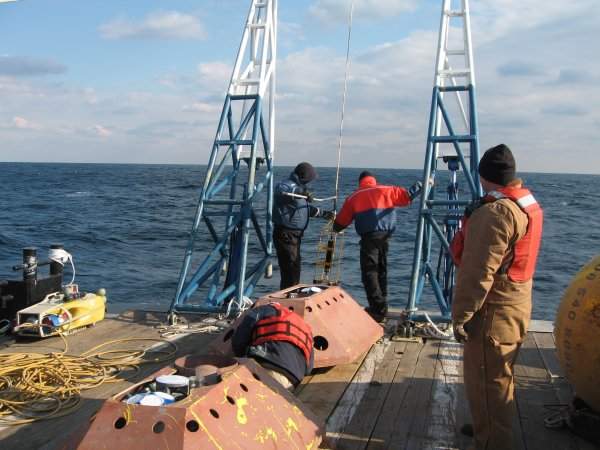
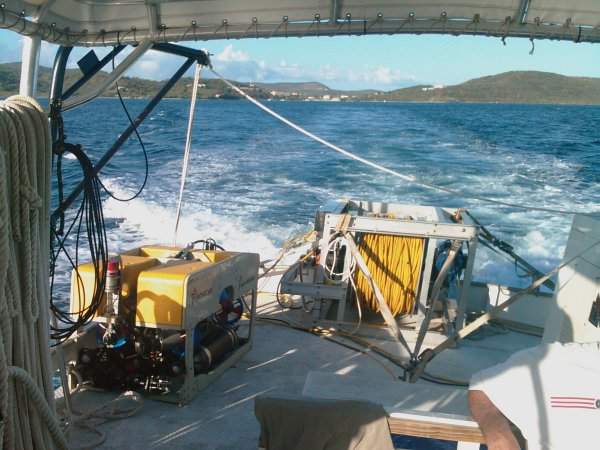
With a focus on reducing the required vessel size for projects, all of Hibbard Inshore’s remotely operated vehicle systems are set up to be highly transportable. All systems can be air shipped and are designed to be used on vessels of opportunity throughout the world.
We are uniquely experienced and outfitted to provide innovative and cost-effective underwater solutions. Some examples of services we can perform throughout the lifespan of underwater assets are as follows:
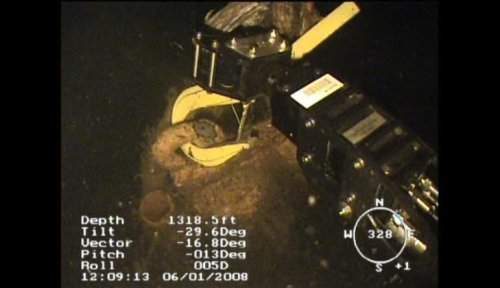
Hibbard Inshore can use its fleet of underwater vehicles to perform inspections and intervention tasks on pipelines, ocean outfalls, inter-island potable water lines, cables, generating assets and oceanographic sensors. In addition, the fleet can be utilized for ordinance surveys.

Hibbard Inshore can carry out the following pre-installation services:
Hibbard Inshore can carry out the following services during underwater installation:
Hibbard Inshore can carry out the following post-installation and maintenance services:
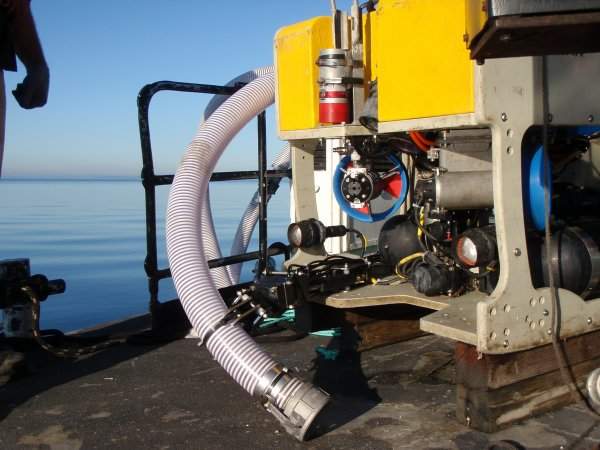
Hibbard Inshore operates both ROVs and AUV / ROVs. Hibbard Inshore operates ROVs that are depth rated to 2,000m, and AUV / ROVs can be provided with up to 1,200m of depth rating. This fleet of vehicles allows Hibbard Inshore to provide near-shore solutions with a wide range of capabilities allowing us to scale the service to the project.
Hibbard Inshore’s ROVs can be used in conjunction with positioning and tracking systems as well as UT gauges and multiple sonar units, including profiling, sector scan, multi-beam, and 3D units.
All of the vehicles come with low-light monochrome and color zoom cameras. In addition, Hibbard Inshore can provide ROV-based pipe tracking systems and a variety of electrical or hydraulic tools. These tools, including cutters, manipulators, torque tools, drills, and custom tools, can be added for intervention tasks.
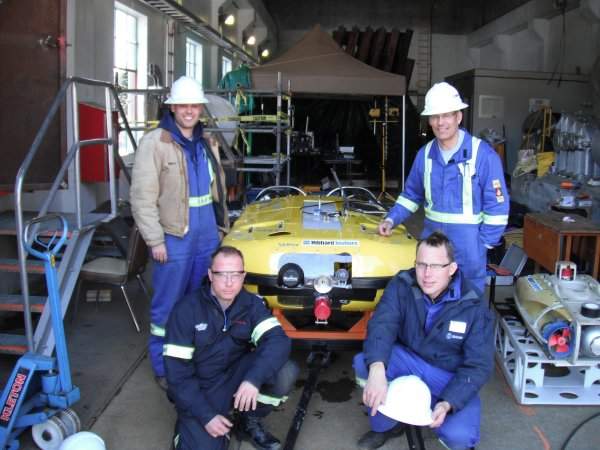
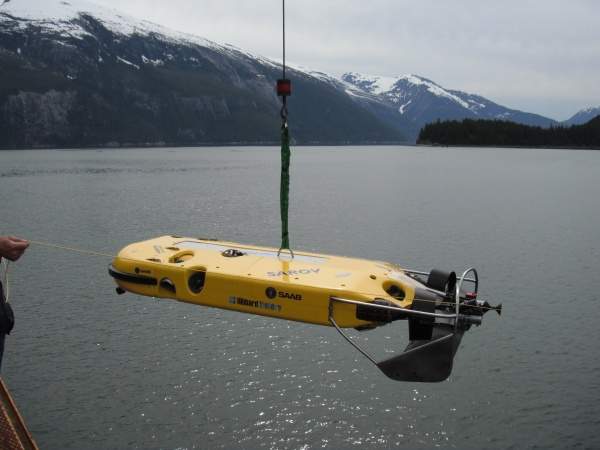
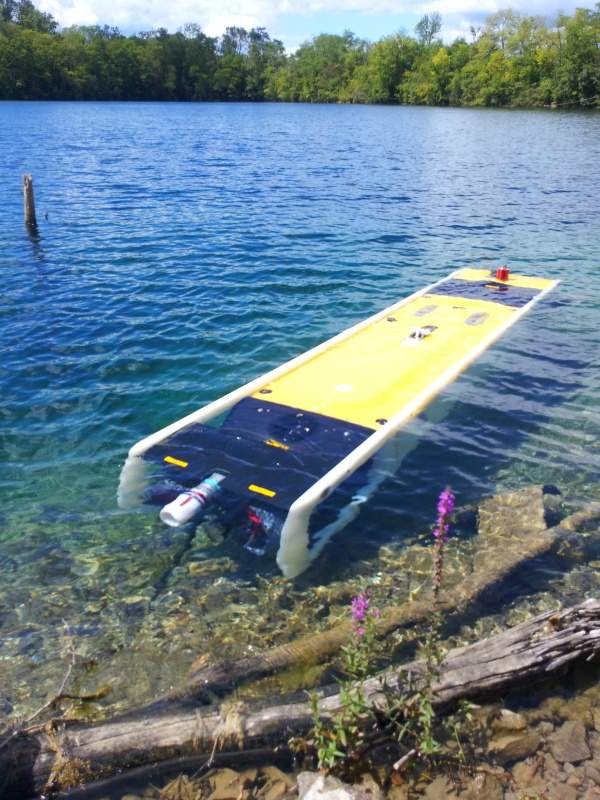
Hibbard Inshore provides advanced hybrid AUV / ROV services for bottom survey, mapping and object location. The Hibbard Inshore hybrid AUV / ROV comes standard with cameras, sonar, GPS, inertial navigation system, and Doppler velocity log to accurately track position while surveying.
Surveys can be performed in a grid format or by following other preset routes. Pipelines and cables can be followed and inspected while the hybrid AUV / ROV performs object avoidance as in the case of manifolds along a pipeline.
In addition to more conventional AUV applications, Hibbard Inshore also runs the hybrid AUV / ROV in an ROV mode over a fiber optic tether. The hybrid AUV / ROV is particularly useful in its design as it can stop, hover, and closely examine a point of interest. Traditional AUVs are limited to operating only in cruise mode due to instability at zero speed.
The ability of the hybrid AUV / ROV to operate in ROV mode with real-time maneuvering control and real-time data visualization can present cost savings to our customers. This eliminates the need to carry two separate vehicles to the site.
During the initial portion of a survey in AUV mode, points of interest would be identified and cataloged. The same vehicle – without returning to port – can then visit all of the points of interest in the catalog by switching the hybrid AUV / ROV to ROV mode. Traditionally, a survey would require two separate vehicles that either would be deployed during two separate trips or would collectively require a larger vessel for deployment.
Hibbard Inshore has released a free brochure detailing its impressive range of remotely operated vehicles (ROVs), as well as specifications, applications and key features.
Hibbard Inshore has vehicles that are rated to work at depths of up to 2,000m and so can get to areas that would be otherwise unreachable by divers. This capability gives our customers the option to complete work without dewatering even when the task area is restrictive and can save on project costs as well as on undue stress to the structure resulting from dewatering.
Leading underwater service provider Hibbard Inshore has announced that it will be exhibiting at Asia 2014.
Inside Australia's Snowy Mountain hydro scheme, leading underwater service provider, Hibbard Inshore, say they have broken the record for the longest tunnel inspection by a tethered vehicle using their newest long-range vehicle, the Saab Seaeye Sabertooth.
Leading underwater service provider, Hibbard Inshore, recently broke the record for the longest distance tunnel inspection performed by a tethered vehicle, using their newest long range vehicle, the SAAB Sabertooth.
Hibbard Inshore will be exhibiting at the Canadian Dam Association conference and exhibition at booth 36 in the Fairmont Queen Elizabeth Hotel in Montréal from 5 to 10 October.
Hibbard Inshore has announced that it will be exhibiting at Hydro 2013.
Leading underwater service provider Hibbard Inshore, along with partner Elétrica Paulistana, has announced that it will appear at HydroVision Brasil 2013.
Leading underwater service provider Hibbard Inshore has announced that it will be exhibiting at ICOLD 2013. The conference will be held 12 to 16 August in Seattle, Washington.
Leading underwater service provider Hibbard Inshore announced that it will be exhibiting at HydroVision 2013.
Leading underwater service provider Hibbard Inshore is pleased to announce the launch of their newly-developed website.
Leading underwater service provider Hibbard Inshore has recently deployed its newest hybrid vehicle from SAAB Seaeye. The Sabertooth is a hybrid ROV / AUV that is able to travel up to 20km+ (tethered) and operates with up to 12 hours of battery life (untethered). Whether the vehicle is in AUV or ROV mode, it is capable of holding station and altitude while maintaining stability. Because of this ability, it allows for a single vehicle platform to perform advanced survey, inspection, and light intervention tasks.
Leading underwater service provider, Hibbard Inshore announces that it will be exhibiting at Hydro 2012. The Conference will be held in Bilbao, Spain, on the 29-31 October 2012.
Leading underwater service provider, Hibbard Inshore announces that it will be exhibiting at HydroVision Brasil 2012. The Conference will be held in Rio de Janeiro, Brazil 25-27 September 2012.
Leading underwater service provider, Hibbard Inshore, has announced that it will be exhibiting at the Annual Canadian Dam Association Conference in Saskatoon, Canada, 22-27 September 2012.
Leading underwater service provider, Hibbard Inshore, has announced that it will be exhibiting at the Association of State Dam Safety Official's national conference, 16 - 18 September 2012, in Denver, Colorado.
Hibbard Inshore will be exhibiting at the HydroVision International Conference, 17-20 July 2012 in Louisville, Kentucky, US.
Leading underwater service provider, Hibbard Inshore announces that it will be exhibiting at the Association of State Dam Safety Official's Southeast Regional Conference, which takes place between 6 and 9 May 2012 in Louisville, KY, US.
Leading underwater service provider, Hibbard Inshore has announced the newest addition to its remotely operated vehicle (ROV) fleet - the Mojave.
Hibbard Inshore, the Michigan-based deep tunnel and underwater specialist, is first to order the new Saab Seaeye Sabertooth hybrid long-range AUV / ROV.