The Greater Plutonio development, comprising the Galio, Cromio, Paladio, Plutonio and Cobalto fields, lies in 1,200m to 1,600m deep water, approximately 160km north-west of Luanda in the Block 18 concession, offshore Angola.
The partners involved in Block 18 concession are BP (46%), Sinopec International (37.72%) and Sonangol P&P (16.28%).
Recommended White Papers

Recommended Buyers Guides

Greater Plutonio was discovered between 1999 and 2001 and is the first BP-operated asset in Angola. It has total estimated reserves of about 750 million barrels, making it one of the biggest off Angola’s coasts.
In 1999, BP drilled Plutonio wells and Platina (in the west of the block), using the deepwater drillship Pride Angola, followed by Galio, Paladio, Cromio and Cobalto in 2000. They are all located within 20km of each other.
Later discoveries included the Cesio and Chumbo fields, slightly further to the south and west. They are being developed with Platina.
The Greater Plutonio development was approved in early 2004. Originally, BP Angola and Shell Exploration and Production Angola BV hold Block 18’s exploration permit under a production-sharing contract with Angola’s state-owned oil company, Sociedade Nacional de Combustveis de Angola (Sonangol).
Greater Plutonio development background
The development of Greater Plutonio, with an estimated cost of $1bn, presented several challenges. The fields are spread over a wide area (35km from Platina to Cobalto) with water depth varying from 1,200m to 1,600m. In addition, the group of fields involves reservoirs at different stratigraphic levels.
The joint development used 43 subsea wells, 20 producers, 20 water injectors and three gas injectors, tied back to a single spread moored FPSO facility to process produced fluids and export crude.
It features a subsea production system with intelligent well technology. The subsea system is the longest single riser tower system of its kind in the world. At about 1,250m, it connects the FPSO to a network of subsea flowline and control systems that include 150km of flowlines, nine manifolds and 110km of instrument and control umbilicals.
The project features some innovative and novel technologies such as a distributed temperature sensing system linked to downhole flow control of water injection, subsea multiphase metering and running trees on wires.
Greater Plutonio FPSO details
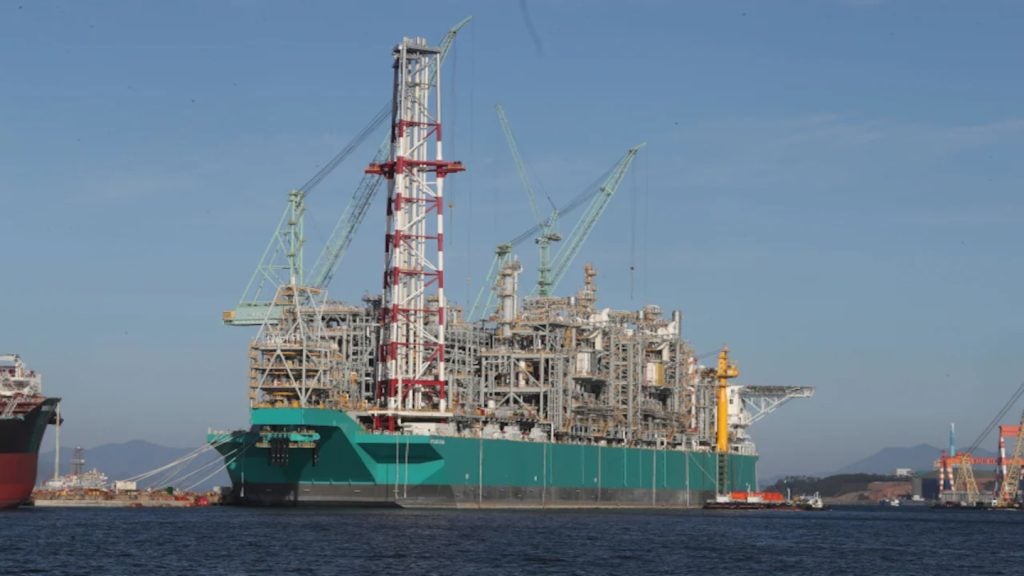
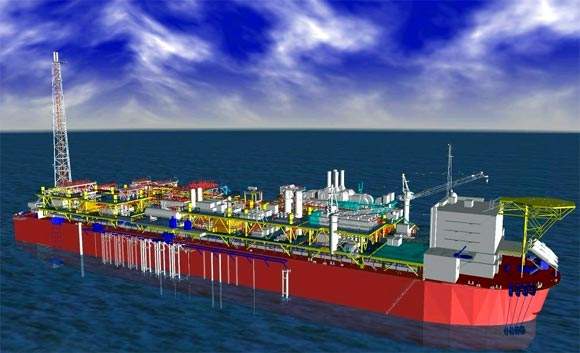
The 310m-long, ‘all-electric’ FPSO has an oil storage capacity of 1.77 million barrels, oil processing capacity of up to 240,000 barrels of oil per day (bpd), produced and treated water injection rate of 450,000bpd, and gas handling capacity of up to 400 million standard cubic feet (MMscf) per day.
It is held in position by 12 mooring lines connected to anchor piles on the seabed. The manifolds, flowlines and risers connect the wells to the FPSO for offloading to tankers via a remote offloading system. The gas produced is exported to the Angola LNG scheme or re-injected into the reservoirs.
With a three-and-a-half-year development timeline, production started on 1 October 2007 and is expected to reach 250,000 barrels of low-sulphur medium gravity crude per day. Capital expenditure for the development has been estimated at $4bn over the life of the fields. The FPSO celebrated the delivery of 600 millionth barrel of oil in 2020 since its commissioning in 2007.
Drilling campaign in Block 18
In October 2020, BP started a drilling campaign in Block 18, using drillship DS-12. This marked the beginning of the Platina project, the second phase of development in the block which will be a subsea tie-back to the Greater Plutonio FPSO. The drilling project aims to unlock 44 million barrels of oil estimate reserves and will add 30,000bpd to block 18 production at the peak.
The drillship DS-12 arrived in Angola in September 2020 to execute the drilling programme. A total of four wells (two production and two injection ones) will be drilled and completed. Two cargo vessels will support the rig with one of the two equipped with remotely operated vehicles (ROV) to support operations and emergency response.
The project was approved for development in December 2018 with the first oil expected in the fourth quarter of 2021.
Contractors involved
BP awarded FMC Kongsberg Subsea a $270m contract to supply subsea systems and related services. The FMC unit’s scope of supply for the entire project included 45 subsea trees and associated structures, manifolds and production control systems, as well as connection systems for flowlines and umbilicals.
In 2005, BP signed a further $80m contract with FMC Kongsberg for the supply of subsea systems covering installation services and local Angolan supply. FMC Technologies also supplied technical services related to installation and start-up.
BP also awarded a $730m field development contract to a consortium of Stolt Offshore and Technip. The contract covered engineering, procurement, fabrication and installation of risers, umbilicals and flowlines to serve all the fields. Stolt Offshore led the consortium, installing 75km of 12in insulated production, gas injection and service flowlines and 103km of umbilicals. The consortium also installed 12 FPSO mooring lines, the production manifolds and a single riser tower to hook up the FPSO.
Kellogg Brown & Root oversaw the engineering, procurement, construction and management, and Hyundai Heavy Industries fabricated the FPSO hull and topside equipment, at an estimated cost of $650m. Emerson was awarded $9m for the automation of offshore oil production.
WellDynamics and BP signed a multi-well contract for the provision of SmartWell downhole flow control and ancillary completion equipment to manage water injection. The project required equal numbers of oil production wells and water injection wells.
The water injection wells provide reservoir pressure support and sweep efficiency to ensure optimal reserve recovery. An additional three gas injection wells are used for reservoir pressure support and to dispose of associated gas production.
Transocean was engaged to provide drilling contract services for the development.