

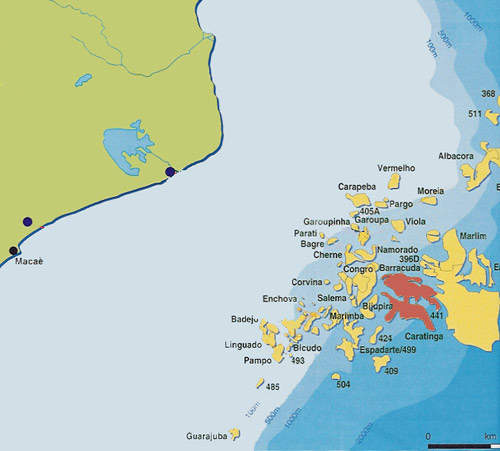

The Barracuda and Caratinga fields lie 160km east of Macae in block BC-50B, offshore Brazil. Together, they will add 30% to the current one million barrels per day output from the Campos Basin region. The two fields cover a combined area of 230km2.
The fields lie in water depths of 785m in Barracuda and 1,035m in Caratinga, although some wells sit in deeper water, down to 1,148m. Recoverable reserves for Barracuda are estimated at 867 million barrels of oil and 10.7 billion cubic metres of gas, while Caratinga, to the south, contains an estimated 362 million barrels and four billion cubic metres of gas. Since 1998, the fields have produced from 20 wells tied back to the Petrobras P-34 floater.
Recommended White Papers

Recommended Buyers Guides

New discoveries
In May 2010 Petrobras reported two light oil discoveries in the Caratinga field. The first accumulation was a post-salt reservoir discovered at a depth of 3,950m by well 6-CRT-43-RJS. The reservoir is estimated to contain about 105 million barrels of oil.
The second accumulation was a pre-salt reservoir discovered at a depth of 4,275m. The reservoir is an extension of a previous discovery made by Petrobras in February 2010. The reservoir is estimated to contain 40 million barrels of oil. The discovery was made by exploratory well 6-BR-63A-RJS drilled by Diamond Offshore’s Ocean Worker semi-submersible rig.
The new discoveries will be developed following tests to evaluate their productivity and may be linked to the P48 platform. Petrobras is expected to submit an evaluation plan to the National Petroleum Agency for the new discoveries.
Barracuda and Caratinga contracts
The Petrobras-owned Barracuda and Caratinga Development Corporation awarded the $2.6bn field development contract to Halliburton’s Kellogg Brown & Root (KBR) and Halliburton Energy Services business units.
This contract covered a full engineering, procurement, installation and construction (EPIC) contract, which included the construction of the wells and the fabrication and installation of flowline and risers, as well as the construction and installation of two FPSOs.
Development of the Barracuda field was done in two phases, with the pilot system and the final system. The field came onstream in late 2004. The final system was developed by FPSO P43, which is hooked by a spread mooring system at a depth of 800m.
The field has 34 wells, out of which 20 are production wells and 14 injecting wells. Barracuda produces an average of 170,000bopd and Caratinga produces 141,000bopd. The Caratinga field has 21 wells – 13 production and eight injection wells hooked to the Caratinga Production platform.
In September 2009 Framo Engineering was awarded a contract to install a multiphase pumping system at the Barracuda field. The helicon-axial-type pump will be the first-of-its-kind to be installed. It will pump oil, water and gas from a satellite well in the field to the P48 platform.
Installation of the system will help to increase the oil production and recovery rate. It will also help to produce from wells located away from the production platforms.
Subsea development
The EPIC contract covered the construction of 55 wells (22 horizontal producers, two multilateral horizontal producers, eight horizontal injectors and eight piggyback injectors). The development also included the 15 old wells connected to the P34.
Part of the produced gas was used for gas lift in the wells, while water injection strategies demand between 200,000 and 250,000bpd. The drilling is being carried out by Petrobras under a subcontract to KBR. Between four and seven rigs operate in the field simultaneously, including the Transocean Driller, Diamond Ocean Alliance and R&B Falcon’s Peregrine III.
FPSOs P43 and P48
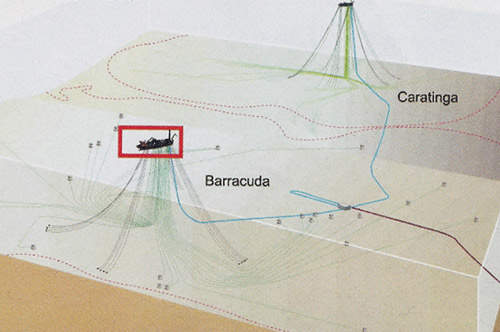
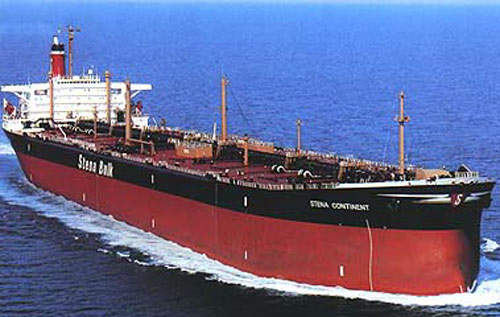
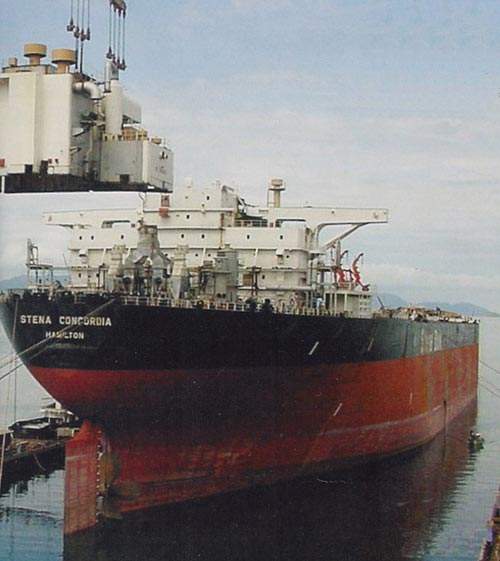
The development is based on two large FPSOs, which KBR bought from Stena. These FPSOs were planned be moored 12.7km apart.
Barracuda uses the P43, originally Stena Continent, which was converted at the Jurong Shipyard in Singapore. The topsides were integrated at the Maua Jurong yard in Niteroi near Rio. Oil production from P43 began in December 2004.
Caratinga was developed by converting Stena Concordia into the P48. This work was carried out at the BrasFels yard in Angra dos Reis, near Rio. Each of the FPSOs has a storage capacity of two million barrels. In addition, each FPSO has production capabilities of 150,000bpd. The FPSOs are moored by 18 polyester and chain lines each via a taut-leg system.
The oil production from P48 started in February 2005. The subsea wells are connected individually to the FPSO by flexible risers. The total cumulative riser length will be 420km or over 170 reels. Each well will have a production flowline and annulus line.
On Barracuda there are 81 pull-ins while Caratinga has 52 pull-ins. Both have 26 spare slots. These flexible risers range in size from 4in to 9.5in and are manufactured by Wellstream. Another 40 reels contain 243km of control umbilicals.
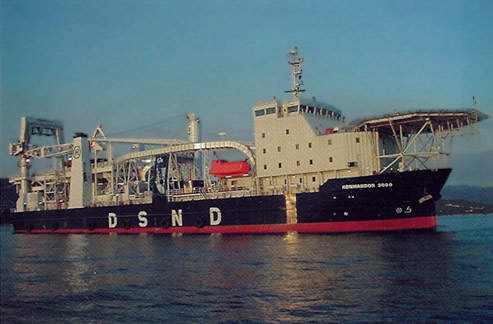
Halliburton KBR used reel vessel Toisa Perseus and DSND’s Commander 3000.
Barracuda and Caratinga export
Oil is offloaded into a shuttle tanker from the two FPSOs, while the gas is piped via two 9.5in diameter gas export risers to a 60t pipeline end manifold. A 12in gas export riser takes it the PNA-1 platform.
