

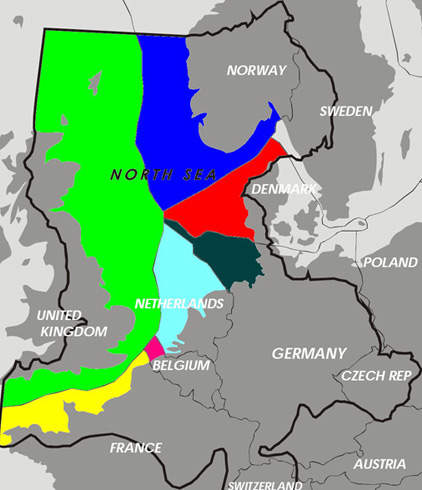
Beryl Field is located about 335km north-east of Aberdeen on the United Kingdom continental shelf in Block 9/13. The project covers an area of around 12,000 acres in water depths ranging from 350ft to 400ft.
ExxonMobil Corporation’s Mobil North Sea Limited was the operator of the field. In January 2012, Apache Corporation acquired all the assets of Mobil North Sea including the Beryl field. It is now the operator of the field with 50%interest. Hess Limited holds 22.22%, Enterprise Oil Limited has 22.78% and the remaining 5% share is held by OMV (UK) Limited.
Recommended White Papers

Recommended Buyers Guides

The field was discovered in 1972 and named after Beryl Solomon, wife of Mobil Europe president Charles Solomon. New drilling activities at the field were announced in September 2009. The co-venturers agreed to provide the required funding.
Geology
The field geology is principally made up of sedimentary layers. It is composed of three layers: the Middle Jurassic coastal deltaic sediments, Upper Triassic to Lower Jurassic continental and marine sediments, and Upper Jurassic turbidites. Beryl Sandstone forms the primary reservoir in the field. Production from Upper Beryl during March 1984 was about 179 million barrels.
The hydrocarbons are recoverable from sandstone reservoirs ranging from Upper Triassic to Upper Jurassic. Six reservoir horizons of Upper Triassic to Upper Jurassic periods contain hydrocarbons. Almost 78% of the total recoverable reserves are located in the Middle Jurassic formation, which is the main reservoir.
Field development
The field is sub-categorised into two producing areas: Beryl Alpha, which includes the initial discovery well, and Beryl Bravo, located to the north.
The field operator received the block in 1971 and the 9/13-1 discovery well was drilled in 1972. The Beryl A platform was tied in 1975 and the other platform, Beryl B, was tied in 1983.
Development, drilling and production started in 1976 with an estimated 25-year production period.
Reserves
Total reserves at Beryl Field were estimated to be 2,100MMBL of oil (1,400MMBL at Beryl A and 700 MMBL at Beryl B) and 2.8TCF of gas. The estimated recoverable reserves are approximately 800MMBBL of oil and 1.6TCF of gas.
Drilling
Of the wells drilled up to 1984, 28 were oil wells, three were gas, three were water, three were gas injectors, three were water injectors and four were abandoned and drilled again.
New drilling activities announced in 2009 include drilling of three wells, initially from the Beryl A platform. The drilling programme is expected to cost about $200m and require 80 more workers. Production from new wells will compensate for reduced production from existing wells.
In May 2012, Apache announced the completion of an extension well. The well, B72, encountered 305ft (true vertical depth) of net oil pay in three separate reservoir units. It produced 11,625 barrels of oil per day and 13.1 million cubic feet of natural gas per day.
Apache is planning to conduct a new 3D seismic survey in summer 2012.
Production
Production at the field began from Beryl Alpha (Beryl A platform) in 1976. Beryl Bravo began producing oil in 1984.
The Bravo field reported an aggregate cumulative production of about one billion barrels of oil and condensate in 2009. The licence for oil and gas production will expire in 2018.
Beryl A platform
The Beryl A platform is based on a Condeep-type structure, which has been placed on its own weight of 200,000t. The platform can accommodate 864,000 platforms, which can further accommodate 864,000 barrels of storage. It is a fixed gravity-based concrete platform and features a main production platform, a bridge linked riser access tower and a flare tower.
The platform does not have a crude oil storage facility. A test separator running simultaneously parallel with an inlet separator for well testing can also be used as alternative source of fuel gas.
The separation of oil, gas and water is achieved through two stage separation trains, A and B. Train B manages all Beryl Alpha’s own platform wells along with fluids from Nevis and Ness subsea developments.
Pipeline
Oil from Beryl Bravo is pumped through a pipeline to Beryl Alpha through an atmospheric separator. Oil is initially stored in a concrete structure and is transferred to shuttle tankers through single point moorings.
The gas is distributed through the Scottish Area Gas Travels (SAGE) transportation and processing system. SAGE started processing gas from Beryl Field in 1992.
