

In 1998, Russia and Turkey signed an intergovernmental agreement for the sale of 565bcf a year of Russian natural gas. In order to implement the agreement, the Blue Stream Pipeline Company – an equal partnership between ENI and Gazprom – was formed to operate a pipeline between the two countries via the Black Sea.
The basic and detailed design phases of the pipeline were awarded to Saipem under an EPCI contract.
Recommended White Papers

Recommended Buyers Guides

Blue Stream pipeline
The pipeline costs $3.4bn and will carry, at full capacity, 16 billion cubic metres of natural gas from Russia to Turkey.
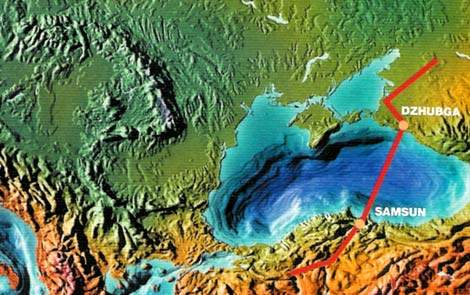
The pipeline consists of three main parts. The route comprises a 222-mile section in Russia from Izobilnoye to Dzhugba on the Black Sea Coast (the Russian onshore section), a 235-mile section on the bottom of the Black Sea connecting Dzhugba to Samsun on the Turkish coast (submarine section), and a further 300-mile link from Samsun to Ankara (Turkish onshore section).
The pipelines consisted of a pair of 24in OD steel lines with a wall thickness of 31.8mm. These lines were installed in parallel to each other at a nominal separation distance of between 5m and 100m excluding the Russian Continental Slope, where different routes were selected. The routes were called E1 (eastward route) and W2 (westward route).
Pipeline across the Black Sea
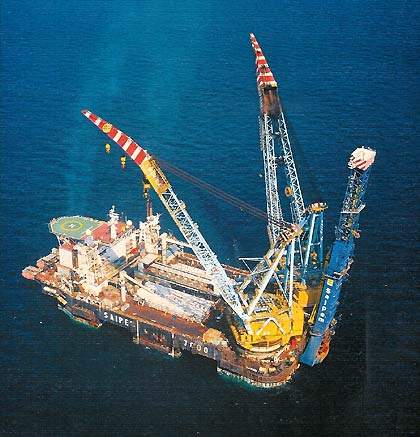
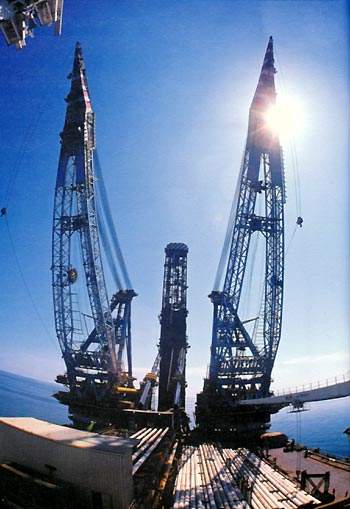
The shallow water sections of up to 380m were installed by the Castoro Otto. The deep water sections of up to 2,150m were installed using the J-lay method by the crane vessel Saipem 7000. The offshore work began at the end of mid-2001. Saipem 7000 crossed the Bosphorus Strait in August 2001 and began the deepwater laying work in October 2001.
Previously, the Saipem 7000 was modified with a novel pipe installation system, making it the only ship in the world capable of laying pipelines at such depths.
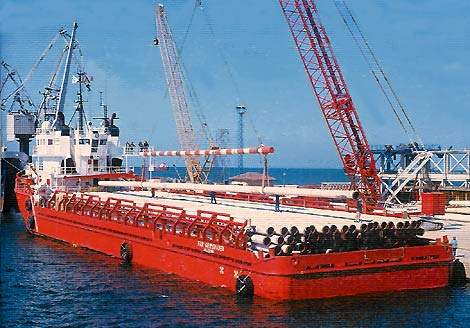
Saipem developed a purpose-made welding system comprising three Presto twin-torch welding units mounted on a rotating carousel. This system uses strings of quadruple joints, 12.1m each welded into 48.8m units. These quadjoints were transported to the vessel from an offshore base.
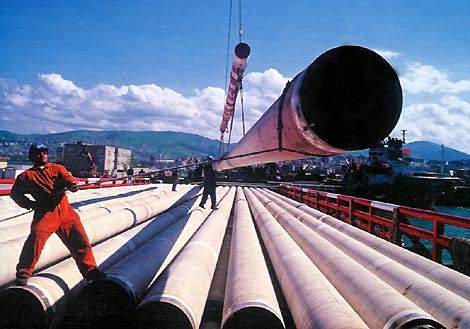
The prefabrication of the quadjoints required a purpose-built fabrication plant in Samsun, occupying 90,000m². In total, this loaded out 14,557 joints, which required 43,671 girth welds and 8,673 anodes, as well as field coatings. A SAWL 1 448 SF grade linepipe was used.
A consortium of Nippon Steel, Sumitomo, NKK and Klawasaki steel supplied 690km while Corus UK supplied a further 89km of linepipe. Much of the pipes were coated by BSR in Hartlepool, England, and Price Coaters in Leith, Scotland.
The pipelines system also required 17km of 652mm OD by 52.7mm buckle arrestors. There were also 10,438 bracelet anodes from the UK and another 15,032 from Singapore.
Blue Stream pipeline shore pull-in
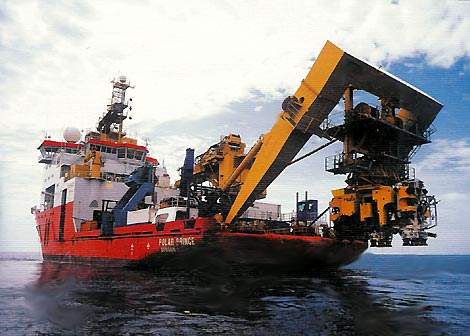
The linking of the pipeline sections also involved shore approach works at the Russian and Turkish landfalls. There are emergency shutdown valves at the interfaces. Pre-trenches were excavated at a water depth of 10m, using onshore excavators and dredgers.
Pipe joints of 12.2m for the shore pull-in were coated with 45mm of concrete. At the Russian side the Castoro Otto, minus stinger, pulled the W2 line ashore first, then the E1 via a 300t return sheave installed on the beach. It then proceeded to the Turkish side.
In October 2002, construction on the pipeline was completed and natural gas supplies through Blue Stream began in February 2003. The flow of natural gas will gradually reach 16 billion cubic metres in 2007 in accordance with the Natural Gas Purchase Sale Agreement.
The pipeline was officially inaugurated on 17 November 2005. In 2007, it supplied 9.5 billion cubic metres of gas. The gas pipeline is designed for a capacity of 16 billion cubic metres per annum. As of September 2010, approximately 51 million cubic metres of gas was being supplied a day.
Blue Stream 2 pipeline
Blue Stream 2 was first announced in 2002. In August 2005, Vladimir Putin and Recep Tayyip Erdogan officially proposed Blue Stream Two and announced the decision to expand Blue Stream One to South East Europe.
Blue Stream Two was expected to become a direct competitor of the Nabucco pipeline by transporting an additional 16 billion cubic metres of gas from Russia to Turkey. It was to run along the same route as Nabucco pipeline in parallel to Blue Stream One on the Black Sea. In 2007, however, Blue Stream Two was shelved, and instead the South Stream project was announced.
South Stream project, which is scheduled for completion in 2015, will partially replace the Blue Stream One expansion. It will run from Russia to Europe, bypassing Ukraine and Turkey.
In 2009, Putin came up with a new route for Blue Stream Two. Instead of running east-west as planned earlier, the proposed pipeline will run parallel to Blue Stream One on Black Sea, extend overland in Turkey and trend north-south across Anatolia, up to the Mediterranean coast.
