

Discovered in July 2000, Kashagan was described as the largest field found in the past 30 years, the largest outside of the Middle East, with a projected output close to that of the Ghawar field in Saudi Arabia.
The field is being developed by a group of partners, including Shell (16.81%), Exxon Mobil (16.81%), Total (16.81%), China National Petroleum Corp (CNPC-8.33%, which was acquired from ConocoPhillips for $5bn in 2013), Kazakh state-run oil company KazMunaiGas (16.81%), INPEX (7.56%) and AgipKCO (Eni) (16.81%). Eni is responsible for phase I of the field’s development, while Shell is responsible for production operations.
Recommended White Papers
Recommended Buyers Guides

The project suffered several delays and costs increased from $57bn to $187bn. The cost estimate for phase I was increased to $46bn in January 2012, from the original estimate of $24bn.
A new joint operating company North Caspian Operating Company (NCOC) became the operator of the field.
In January 2010, NCOC announced that the budget allocated for the development of the Kashagan field was reduced to $7bn from the earlier $10bn. NCOC spent $40bn in developing the field up to 2013.
In August 2010, KazMunaiGas announced that the phase II development of the field would be delayed until 2018-19. In February 2012, a $45bn funding was approved by Kazakhstan under the windfall oil fund to develop the field. The funds will be handed over between 2013 and 2015.
Kashagan oil field production and gas leakages
The first production from the field was achieved in September 2013. The production had to be, however, halted for a few weeks as gas leaks were detected from a pipeline connecting the field to the onshore processing facility. Sulphide stress corrosion was identified as the cause of the leaks.
The consortium planned to produce 180,000bpd of oil from Kashagan by the end of 2013, which was expected to rise up to 370,000bpd upon completion of the second phase, but production has since been suspended due to the replacement of the pipeline.
Kashagan field, Kashagan East 1 and West 1 geology
Kashagan is a carbonate platform of the Late Devonian to middle Carboniferous age. The reef is about 75km long and 35km across, with a narrow neck joining two broader platforms (Kashagan East and Kashagan West).
The top of the reservoir is 4.5km below sea level and the oil column extends for more than one kilometre. The seal is middle Permian shale and late Permian salt.
The reservoir consists of limestone with low porosities and permeability. The oil is light, with 45° API gravity with a high gas-oil ratio and very high H2S content of 19%. The field is heavily overpressured, which presented a significant drilling challenge.
The figures for oil in place range between 30 billion and 50 billion barrels with a common publicly quoted figure of 38 billion barrels, but because of the reservoir’s complexity the recovery factor is relatively low, about 15-25%.
The Caspian Sea is 30m below sea level. Most of its mean water depth is 208m, although the north-east area is considerably shallower. The field, 75km SSE of Atyrau, lies in just 3.7m of water.
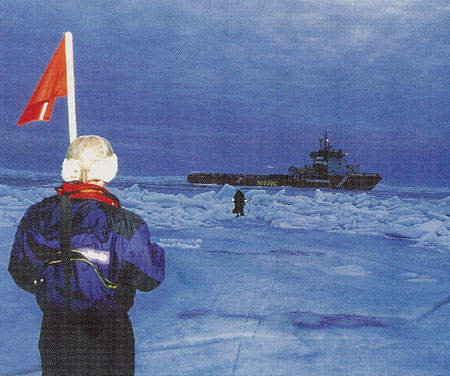
Temperatures can fall below -20°C in winter and a coating of ice, several metres thick, forms in this part of the Caspian Sea for many months.
Discovery of the Kashagan wells
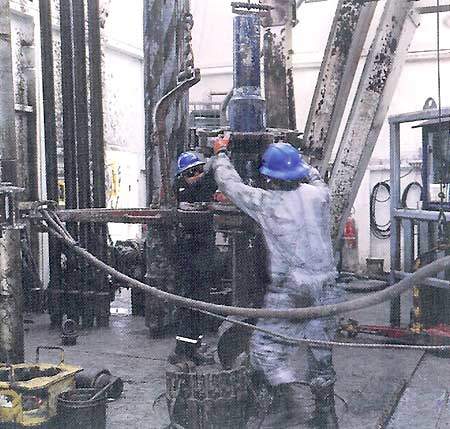
Discovery well Kashagan East 1 was a single vertical well that was drilled in 2000 to a total depth of 5,200m. During tests, the well flowed at a rate of 600m³ of oil a day and 200,000m³ of gas a day on a 32 / 64in choke.
Kashagan West 1 was the second discovery well. Discovered in 2001, tests showed that the well flowed at a rate of 3,400bopd, while the oil gravity measured between 42° and 45° API.
Kashagan East 2 was discovered in late 2001 and was drilled to a depth of 4,142m and flowed at a rate of 7,400bpd. Dresser Services was awarded the integrated drilling contract.
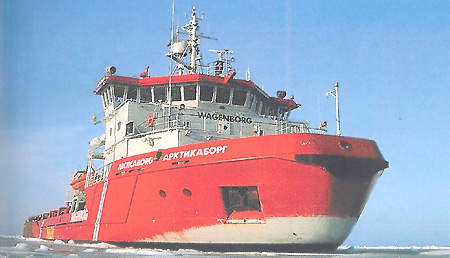
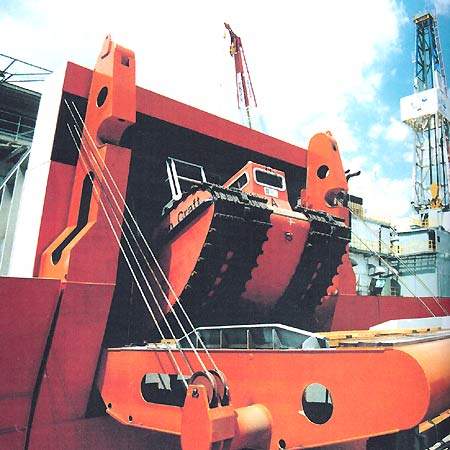
Because of the environmental conditions, icebreaking supply boats were used. Most icebreakers work by using the weight of the ship to crack the ice, but this does not work in the shallow waters of the Caspian, so shallow-draught Arcticaborg icebreakers from Finland’s Kvaerner Masa shipyards were brought in to break the ice, using specially designed propellers. Special tugs were also designed to work in these waters and arrived in the Caspian in September 2002.
Icebreaker tugs built by STX Norway Offshore
JSC Circle Marine Invest’s subsidiary Caspian Offshore Construction operates two icebreaker tugs at the Kashagan field. The tugs were built by STX Norway Offshore under an Nkr450m contract awarded by JSC.
The vessels, which were designed under ice-class notification 1A Super, are 65m long and have a beam of 16.4m.
The tugs feature fire-fighting equipment, rescue operations facilities and towing equipment in shallow waters.
Development of the Kashagan field in Kazakhstan
The development plan for the $136bn project, approved in February 2004, foresees production developing in three phases for proven reserves of about 13 billion barrels.
The field initially produced 60,000bpd and is expected to produce 1.5 million barrels per day by 2021, which is slightly more than Kazakhstan’s total current production.
The project design includes building production hubs on platforms and artificial islands to collect production.
Oil and any gas that is not re-injected is treated at the hubs, before sending in separate pipelines to new onshore treatment plans at Bolashak.
Here, the oil is further stabilised and purified, while the gas drawn for the removal of sulphuric acid is used partly as fuel to supply the energy necessary for the production plants and partly marketed.
The field will feature a total of 40 wells. A total of 20 production wells were operational by 2013.
Sunkar floating production vessel
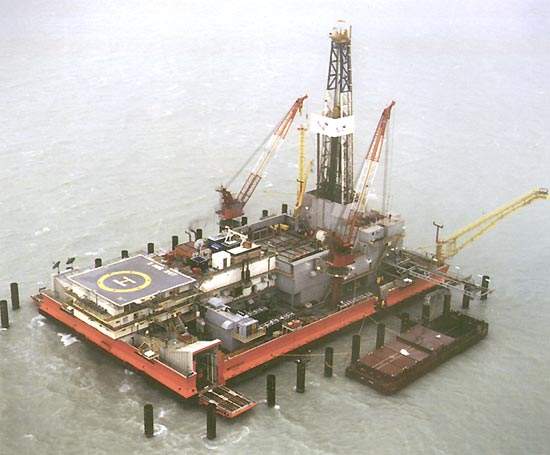
The drilling programme at the Astrakhan yard in the Russian Federation is being carried out by the Sunkar floating production vessel.
This converted swamp barge was re-designed and modified specifically for Caspian service, in a $100m engineering exercise, which included the installation of two four-metre high steel deflector tanks to protect the rig from the ice. The barge measures 85x53m and are 5.5m high and is the largest of its type. It weighs 6,000t and can hold up to 100 people.
In order to minimise supply operations, the platform design required storage tank volumes that were as large as possible. The tanks include 19 ballast tanks (18,869m³), five drill water tanks (1,854m³), five fuel oil tanks (1,364m³), one pollution tank (516m³), four potable water tanks (513m³), one base oil tank for mud (385m³) and one brine tank (224m³).
Support facilities and Kashagan field contracts
Support facilities include a bacterial sewage unit capable of handling 9.5m³ and two electrically driven Alfa Laval freshwater distillers, consisting of two units each capable of 33m³ a day.
Communication is maintained by radio and a satellite voice-and-data link, and there is a 19x19m helicopter deck. Power is provided by four 1,500kW power generators and one 860kW standby generator. Emergency power is available through a 420kW diesel-driven generator.
The rig barge sits on submerged limestone berms that stand less than one metre high. The berm is surrounded by 24 ice-resistant piles, each weighing 70t. With a diameter of 1.6m and a height of 30m, the berms are used to break up ice sheets and reduce forces on the barge.
In October 2008, AgipKCO handed a $31m letter of intent for front-end engineering and design work on phase II of the development to a joint venture of Aker Solutions, WorleyParsons and CB&I.
At the time, Aker Solutions and WorleyParsons were already engaged in executing phase I of the project, carrying out engineering services, fabrication and hook-up.
In April 2010, the Aker and Saipem joint venture was awarded an updated contract for carrying out FEED studies for phase II. The new contract worth $293m replaced the one awarded in 2008.
In May 2009, Aker and Saipem were awarded a $2.6bn contract for the installation and commissioning of pipeline and offshore production facilities of phase I.
The work for Saipem includes oil and gas production from artificial island facilities Island Block A and Island Block D. Installation works were completed in 2013.
In October 2010, Synectics Industrial Systems was awarded a contract to provide an IP networked CCTV system for the project.
The scope of the contract included the installation of more than 300 COEX camera stations and integrating the communication system with Thales carrier-grade, multi-service communication subsystem.
IMPaC was awarded a $700m contract to provide overall stability and detailed design and construction supervision services for the entire rig at the field.
In February 2015, Saipem, through its subsidiary ERSAI Caspian Contractor, received an engineering and construction contract from NCOC. The contract includes the construction of two 95km-long pipelines between the D island in the Caspian Sea and the Karabatan onshore plant in Kazakhstan.
The two pipelines will have a diameter of 28 inches and will be made of carbon steel, internally coated with a corrosion-resistant alloy layer. Each pipeline will have an offshore length of about 65km.
The contract includes engineering, and welding materials, conversion and preparation of vessels, dredging, and installation, burial and pre-commissioning of the two pipelines.
