


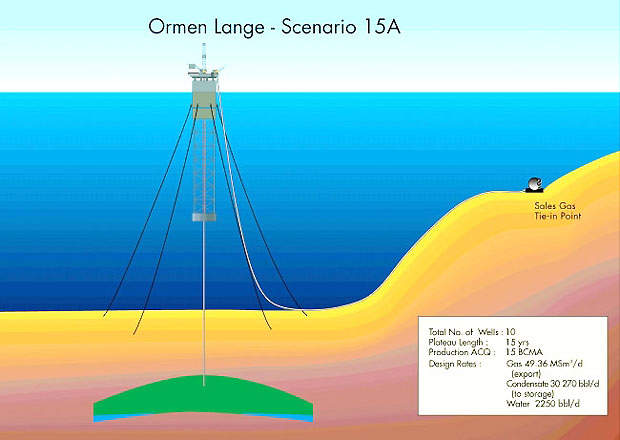
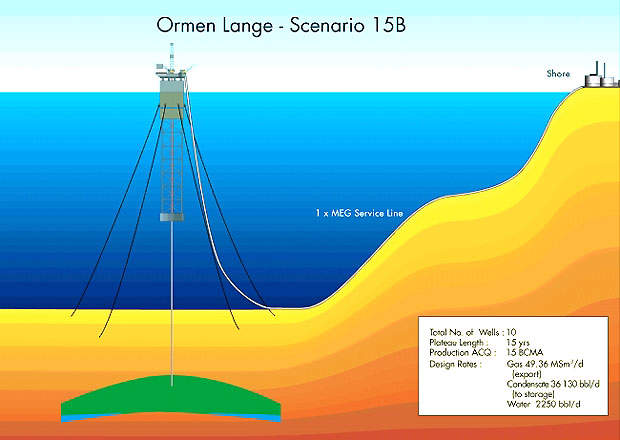
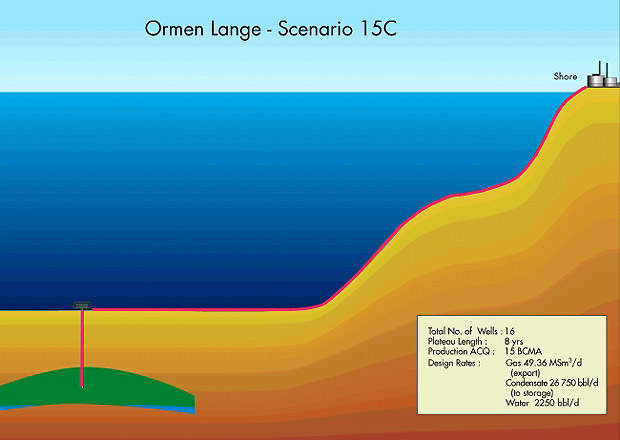
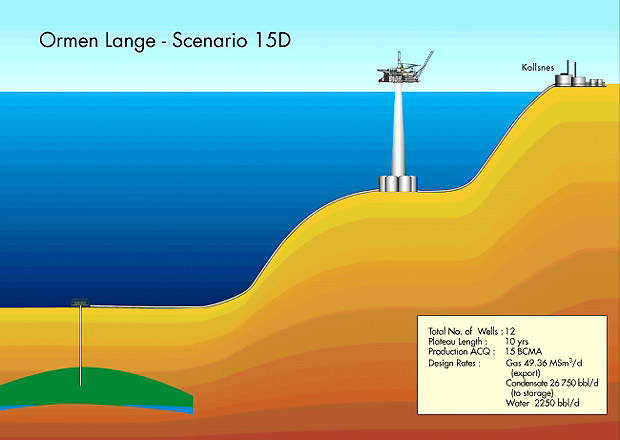
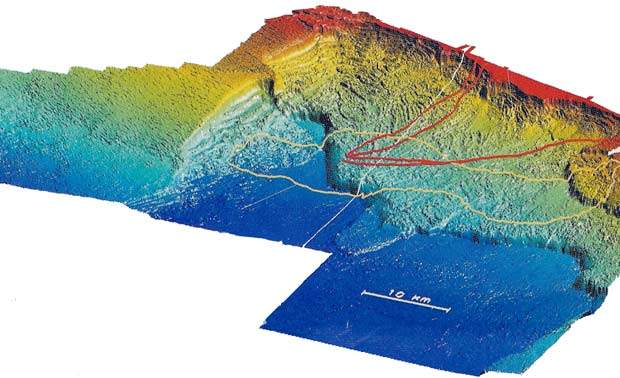
The Ormen Lange field is located in the Norwegian Sea, approximately 140km west of Kristiansund, Norway.
The discovery lies across blocks 6305/4, 6305/5, 6305/6 and 6305/8.
Recommended White Papers
Recommended Buyers Guides

Preliminary estimates show that Ormen Lange is the third-largest gas discovery on the Norwegian shelf.
The discovery well 6305/5-1 was drilled in 1997. Gas production from the field started in 2007.
The field was developed as subsea production for a new onshore gas processing plant at Nyhamna in Aukra, part of More and Romsdal county.
Ormen Lange discovery
Hydro and Shell Norway signed an agreement for sharing responsibilities for the field.
Norsk Hydro is responsible for the development phase, while Shell is responsible for developing the transport of the gas and all the commercial relationships.
The project was operated by StatoilHydro until the development phase. A/S Norske Shell became the operator in the operating phase in November 2007.
The main gas reserves lie in a reservoir in the Vale formation. Drilling has confirmed the original estimated resources of 315 billion square metres of natural gas.
The difficulty in developing the field was due to the water depth and subsea topography. The field lies in a depth of 800m-1,200m, close to the steep back wall left by the Storegga submarine slide, which occurred 7,000 to 8,000 years ago.
The Storegga slide was probably triggered by a major earthquake caused as the land masses rose at the end of the Ice Age, combined with weak sedimentary layers.
Norsk Hydro has carried out a programme of high-resolution seismic surveys, seabed mapping, shallow coring and deep geotechnical drilling.
In August 2000, the extension well 6305/8-1 confirmed gas volumes and a thin layer of oil, measuring a maximum of three metres.
Norsk Hydro drilled the well into a chalk formation using the rig Scarabeo 5 to a total depth of 3,175m.
Field development
The field development consisted of subsea and onshore installations along with gas export system.
The development plan was submitted to Norwegian authorities in December 2003 and was approved in April 2004.
The initial field development plan included installation of two subsea templates.
Later, 24 wells from four subsea templates were planned. Two subsea templates have already been installed.
The third subsea template was ready for installation in May 2009. The fourth template will be commissioned later if required.
The first phase of field development consisted of two subsea templates, pipelines to onshore and an onshore gas processing plant.
Each subsea template has slots for eight wells. The wells were tied to the templates through subsea manifolds.
The gas, condensate and water are transported from subsea templates via two 30in pipelines to an onshore process terminal at Nyhamna. The pipelines were installed by Saipem.
The project required new gas transportation infrastructure to cater for increasing demand for gas in the European market in 2002.
With the development, the project is a major supplier with production meeting 15% of the UK’s gas requirements.
Transportation of gas was planned via a 1,200km pipeline starting from Nyhamna in Aukra to the UK. The proposal to build the pipeline was approved in February 2003.
The pipeline will start from Aukra via the Sleipner installation in the North Sea to Eastington / Dimlington in south-east UK.
The project requires a pipeline with a capacity of at least 60 million standard cubic metres per day.
Ormen Lange production
Gas production from the field started in 2007 with three wells. Three more wells were added in 2008.
Gas production is scheduled to continue for 40 years and is expected to be at peak in 2010.
The field has maximum production capacity of around 70 million cubic metres of gas per day.
Production from the field was stopped temporarily due to cold weather in January 2010, and resumed in the same month.
Contracts
The contract for pipeline installation was given to Solt Offshore AS and Allseas Marine Contractors SA in November 2003.
The deal was valued at NKr2bn and NKr1.5bn respectively.
The EPC and testing contract for the subsea production system was given to FMC Kongsberg Subsea AS in November 2003.
The contract has option for extending services for additional equipment deliveries and was valued at around NKr1bn.
FMC further sub-contracted the subsea template to Grenland Group.
The FEED contract for the onshore processing plant was given to Aker Kvaerner in 2003.
The other contract for construction and installation of slug catcher was given to Aker Verdal in 2004.
An NKr660m contract for transportation and installation of two pipelines was awarded to Saipem in 2004.
Ormen Lange rigs
Spudding of the well was done by the Scarabeo 5 rig. The rig is owned by Saipem.
The West Navigator and Leiv Eiriksson rigs were selected for the second phase of development.
West Navigator is owned by Seadrill and was built in 2000.
It can drill to a maximum depth of 35,000ft and operate at a maximum depth of 7,500ft underwater.
Leiv Eiriksson is a submersible rig owned by Ocean Rig ASA.
It can drill to a maximum depth of 30,000ft and can operate at a maximum depth of 8,200ft underwater.
