

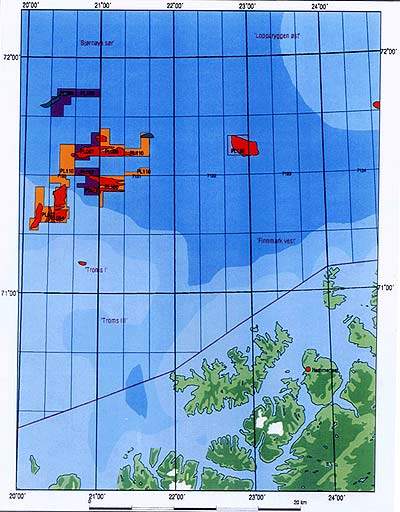


The Snøhvit development comprises three fields – Snøhvit, Albatross and Askeladd. These lie in the Barents Sea, about 140km north-west of Hammerfest in northern Norway. The fields were discovered in 1984 in 250-345m of water and extend across seven production licences.
All licences contain natural gas with small quantities of condensate. The accumulation exceeds 193 billion cubic metres of natural gas, 113 million barrels of condensate and 5.1 million tonnes of natural gas liquids (NGL).
Recommended White Papers

Recommended Buyers Guides

Snøhvit is operated by Statoil, which holds a 33.53% stake in the field. Other stakeholders include Petoro (30%), TotalFinaElf (18.4%), Gaz de France (12%), Amerada Hess (3.26%) and RWE Dea (2.81%).
Snøhvit field development
A development plan was proposed in 1991, but was halted on economic grounds. Statoil submitted a plan for development and operation of the field in September 2001 that was approved in March 2002. Snøhvit will be developed by a total of 21 wells, including eight production wells and one for injecting carbon dioxide into the seabed.
During 2004-05, six production wells and the carbon dioxide injection well were drilled. The remaining two production wells will be drilled in 2011. In 2005-06, production wells were drilled on Albatross. Both fields came onstream in 2007. The Askeladd field will start production in 2014-15.
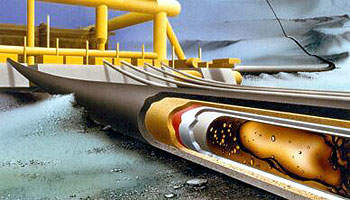
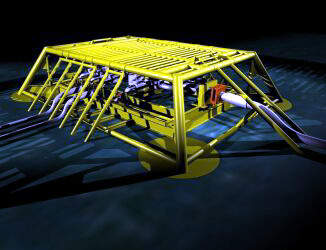
Snøhvit is the first major development on the Norwegian continental shelf without a fixed or floating unit. Instead, a subsea production system on the seabed feeds a land-based plant on the north-west coast of Melkøya, at the entrance to the shipping channel into Hammerfest via a 68cm ID, 160km gas pipeline. In addition two chemical lines, an umbilical and a separate pipeline for transporting carbon dioxide were laid in 2005.
Both the subsea production system located on the field and pipeline transport are monitored and controlled from a control room at Melkøya, where operators open and close valves on the seabed 140km away with signals transmitted along fibre-optic cables and high-voltage electrical and hydraulic power lines.
The potential routes for the pipelines and cables were appropriately mapped and analysed, along with the areas where the subsea installations were to be sited in order to ensure the most favourable location for pipelines and equipment.
The work was carried out from the Normand Tonjer, which was followed by geotechnical surveys on the field and along the pipeline routes by the ship Bucentaur.
Carbon capture and storage (CCS)
In April 2008, Statoil announced that carbon storage had started on the Snøhvit field. Statoil is reinjecting Snøhvit’s carbon dioxide emissions into the ground beneath the gas-bearing formation on the field.
The process reduces carbon dioxide emissions by 700,000t a year when Snøhvit is at full capacity. This is the equivalent of emissions from 280,000 cars.
Natural gas is first pumped to a carbon capture plant at Melkøya. Here, 5-8% of carbon dioxide is removed from the gas and piped back to a 2,600m-deep sandstone formation at Snøhvit, where it sits under the seabed.
Gas liquefation
The unprocessed wellstream arriving at Melkøya is separated and the gas cooled down to liquid form and exported. The carbon dioxide is separated out at the land plant and returned in a separate line for storage underground beneath the seabed.
A liquefaction plant reduces its volume 600-fold by decreasing its temperature to -163ºC. This is carried out on a gas liquefaction barge, which was built at the Spanish shipyard group Izar Construcciones Naval’s yard in Ferrol in a contract worth about Nkr170m. The barge is 9m high, 154m long and 54m wide.
The chosen building approach greatly reduces the need for steelwork on Melkøya, and gives cost savings as well as higher productivity compared with constructing the plant on site.
Following completion, the barge was towed to an outfitting yard where 24,000t of process equipment for the gas liquefaction plant was installed on its deck. From there, it was transported to Melkøya on a heavy-lift ship and installed in a dock blasted out in advance. About 70 cargoes of LNG a year is shipped out from Melkøya.
The annual exports are estimated to be 5.75 billion cubic metres of LNG, 747,000t of condensate and 247,000t of liquefied petroleum gases (LPG). There are long-term contracts with Iberdrola in Spain and El Paso in the US. The total investment included Nkr34.2bn for field development, pipeline and land plant and Nkr5.4bn for ships. Snøhvit started production in September 2007.
