
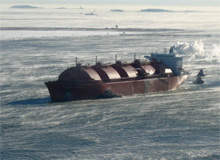
The present global LNG supply-demand scenario makes it likely that there will be a supply crunch worldwide culminating around the year 2015 according to a new report compiled by research and data firm GlobalData. Rising costs, a shortage of gas supplies and global financial meltdown have led to delays in many LNG liquefaction projects. Additionally continued increases in LNG demand, though at a slower rate than previous years, is a primary driving factor for the shortage in supply.
Natural gas company BG Group recently stated that the LNG industry worldwide is expected to witness an LNG supply surge until 2012, which will be followed by a supply crunch. It is estimated that approximately 14 million tons of LNG will be shipped from the Atlantic Basin to Asia Pacific in 2008, almost double the amount sent to Asian buyers in 2007.

Discover B2B Marketing That Performs
Combine business intelligence and editorial excellence to reach engaged professionals across 36 leading media platforms.
Planned liquefaction projects that are expected to commence operations between 2010 and 2012 will boost LNG supplies across the world. Liquefaction terminals or export terminals convert natural gas into liquid form at cryogenic temperature and supply this LNG to import terminals or regasification terminals, which regasify the imported LNG. While regasification terminals represent the demand-side scenario of global LNG industry, the supply side dynamics are controlled by liquefaction terminals. The global financial meltdown delaying planned liquefaction projects coupled with the rapid increase in regasification capacities to 2015 points towards a supply crunch in the medium term.
LNG industry – facing a supply crunch
According to the ‘Global LNG Industry to 2015 Investment Opportunities, Analysis and Forecasts of All Active and Planned Liquefaction and Regasification Terminals’ report from GlobalData, global liquefaction capacity increased at a uniform pace from 121.4 million tons in 2000 to 212.6 million tons in 2008 at an AAGR of 7.0%. Capacity is expected to increase from 212.6 million tons in 2008 to 417.0 million tons in 2013 at an AAGR of 13.5%. No new liquefaction terminals are expected to come on-stream during 2014 and 2015.
The growth in global regasification capacity, especially post 2008, surpasses the liquefaction capacity growth. According to the report, between 2008 and 2015 the global regasification capacity is expected to increase from 462.2 million tons in 2008 to 987.4 million tons in 2015 at an AAGR of 10.8%
Assuming that all the planned LNG regasification and liquefaction terminals commence operations to schedule, between 2009 and 2015, the global demand supply gap of LNG will increase from 362 million tons per annum (MMTPA) to 570MMTPA at an AAGR of 7.6%. The supply gap rises sharply between 2009 and 2011 by over 40% and keeps rising till 2015 when the gap is expected to touch 570MMTPA. This is assuming that all the planned liquefaction and regasification projects start production on time.
The LNG demand-supply gap, rising costs and project delays
Assuming that only 50% of the planned global regasification capacity comes online on its respective due dates, there will still be a demand supply gap even if all the planned liquefaction capacities commence operations as per the current schedule.
Table 4 (below right) shows that there is a demand-supply gap prevalent until 2015 assuming 50% of planned regasification capacities commence operations. The supply shortage is there to stay and will probably become acute in 2012 until 2015. Even considering a conservative increase in LNG demand, LNG demand-supply gap will increase from 37.9 million tons in 2009 to 76.7 in 2015.
New LNG projects worldwide, especially liquefaction projects that require high capital investment, have been hit by rising costs of commodities, labour, and materials. Steel price went up by 300%-350% between 2004 and 2008, and the copper price increased by 350%.
Despite falling net margins for contractors and project developers, they have been hopeful that overall project costs will fall due to dip in commodity prices triggered by the current global financial meltdown.
Investors still remain sceptical about the extent to which new project costs will decline, leading to investment delays and liquefaction project postponements. All these will lead to the slowest global LNG production growth since the 1970s over the next five years.
Global LNG production growth has also declined from 6.2% in 2007 to approximately 4% in 2008. This is primarily due to the delayed commissioning of new ventures in Qatar, Russia and Yemen, technical problems in Algeria and Norway and limited gas supplies to liquefaction plants in Nigeria and Egypt.
There is a lead time of three to four years from a final investment decision (FID) to the final operation of any LNG export project. However, since 2005, only five FIDs have been approved, which will add only 19MMTPA of LNG globally once they commence operations. Even some of these projects are witnessing delays.
Iran, the country with the second largest gas reserves in the world, has several delayed liquefaction projects. According to GlobalData’s report ‘Middle East and Africa LNG Industry to 2015 Investment Opportunities: Analysis and Forecasts of All Active and Planned Liquefaction and Regasification Terminals in Middle East and Africa’, LNG projects in Iran like Persian LNG, Pars LNG, Iran LNG and Qeshm LNG with a total planned capacity of 37.2 million tons, which are due to come on-stream by 2010, are unlikely to commence operation before 2015. The nation’s unresolved nuclear plans with the UN Security Council have led to indecisiveness by western contractors as to whether to start up new projects, leading to withdrawals and delays.
Russia, which has the highest natural gas reserves in the world, has no operational liquefaction facility. Both its planned liquefaction projects – Sakhalin and Shtokman LNG – are likely to get delayed and will commence operations in 2014 at the earliest, due to technical problems in developing offshore gas fields and constructing a subsea pipeline link.
Similarly, Qatar’s new projects including Qatar Gas 2 (train 4 and 5), Qatar Gas 3, Qatar Gas 4 and Ras Laffan LNG III have been stalled as its gas supplies from the North Field are still to be reviewed.
In Africa, Nigeria has a total planned liquefaction capacity of 51MMTPA by 2012. Out of this, a combined, planned liquefaction capacity of 29MMTPA is still awaiting FID approvals. Further, more than 35MMTPA of liquefaction capacity worldwide is awaiting approval in 2009, including the Chevron-led Gorgon project in Australia, ExxonMobil’s LNG plant in Papua New Guinea, Nigeria LNG’s seventh train, Indonesia’s Senoro plant and BG Group’s Queensland project in Australia.
Dealing with a financial crisis
The global financial crisis has injected uncertainty into the LNG market with concerns growing that the credit crunch could affect both demand and supply. The global economic slowdown, together with climate and energy efficiency measures introduced in many developed countries is likely to lead to a relatively slower growth in the demand for LNG.
However, global LNG demand to 2020 and beyond will continue growing, although at a slower rate than the 7.7% per annum recorded between 1998 and 2008. Demand for natural gas is burgeoning in China, India and other countries in the Asia Pacific. China and India, which hold the promise of generating huge markets for LNG post 2010, have finalised major deals with Qatar, Australia and Algeria and are negotiating projects with Nigeria, Russia and Oman, among others. Natural gas as an energy source in Asia in 2007 accounted for 10.6% of total primary energy use, which was substantially lower than the world average of 23.7% and this creates a big opportunity for growth of LNG industry in these markets.
In Western Europe, there has been an increase in LNG demand, with new regasification projects planned by France, Italy, Spain, and the UK. In the UK, the domestic gas production is expected to fall by 10% in 2008, widening the supply gap and increasing the need for additional gas imports. In 2008, the UK imported about 40% of its gas and this is expected to rise to 50% by 2010, with imports reaching 150 million cubic meters a day by 2015. Regasification projects in the UK allow plenty of import capacity but the challenge is to secure LNG supplies.
In addition, several countries want to increase gas usage for environmental reasons. Worldwide, countries are trying to diversify their energy sources and the number of countries participating in the global LNG trade is expected to increase from 33 in 2008 to 43 in 2012. The increasing demand for LNG in Asia-Pacific, coupled with the ability of the markets in this region to pay higher prices, have made it a strong competitor to North American and European import markets in securing future LNG supplies. Between 2012 and 2015, these countries will have adequate infrastructure in place to import significant volumes of LNG, which is expected to increase competition.
With demand set to rise even in the prevailing global financial crisis, coupled with many new liquefaction projects being held up due to uncertain market conditions, a supply crunch seems to be inevitable in the current scenario.
Imbalances among the elements of the LNG value chain – liquefaction, shipping and regasification, have created hindrances in the smooth operation of LNG projects and have long been responsible for a demand supply mismatch in the global LNG industry. High construction costs along with a dip in the number of project approvals due to environmental concerns have led to project delays. Further, the global credit crunch is making it difficult for upcoming liquefaction projects, especially those that are not backed by global oil and gas companies, to get access to capital. With natural gas becoming the fuel of choice globally, LNG demand is set to grow. This surge in demand coupled with low LNG production capacity and the postponement of most of the planned liquefaction projects are leading the global LNG industry towards an acute supply crunch by 2015.


