
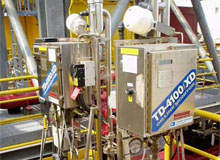
Instruments designed for measuring hydrocarbon concentrations in water have a simplistic but pivotal function in many offshore rigs, refineries and industrial plants.
From ensuring that water discharged from rigs is environmentally acceptable to detecting harmful oil leaks into steam heat exchangers, the equipment plays a crucial role in several sectors.

Discover B2B Marketing That Performs
Combine business intelligence and editorial excellence to reach engaged professionals across 36 leading media platforms.
A fact not always grasped by industry professionals, however, is the degree of understanding and maintenance that must accompany the product.
A CUSTOMISED APPROACH
Turner Designs Hydrocarbon Instruments was formed about six years ago to manufacture electronic and optical devices for measuring oil and hydrocarbon concentration in liquids.
The company specialises in UV fluorescence-measurement technology and its equipment is implemented across the offshore sector, industrial sectors – such as petrochemicals and refineries – and the marine sector.
According to Turner Designs Hydrocarbon Instruments president and founding partner Gary Bartman, such measurement equipment is often customised to meet individual company requirements.
“Our instruments take a sample from the process and monitor the hydrocarbon content on a side-stream,” he says. “It is therefore vital that we evolve the processing of the sample in a manner that can cover the wider market.
“The original design of the equipment was introduced 14 years ago but since then we have adopted various design changes to meet service customer needs. Some of our latest innovations include self-cleaning systems using chemicals or ultrasonics to keep the measurement cell clean.”
Customisation varies according to the instrument’s purpose.
Some perform simple measurement duties and others are designed to validate the treatment of a process.
SAFETY NET
In the case of monitoring an oilfield separation system, the instrument is an additional safety net – ensuring harmful chemicals or oily water is not discharged into the environment.
Because of this the equipment often has to adhere to certain environmental standards.
In the marine sector the equipment is certified by the International Maritime Organization (IMO).
Likewise, some products must be fiercely durable in order to accommodate high pressures and temperatures.
In the steam condensate side of the hydrocarbon business for offshore oil production, the physical design of the flow cell is altered to meet the harsh conditions of the sample.
FLUORESCENT THINKING
The equipment is operated by mid-level technicians and site operators, and plays a constant role in day-to-day operations.
In the offshore arena the operator uses the data from the monitor to adjust processes and prevent sheen on the water after it is discharged.
While not all operations send water directly into the environment, the water must nevertheless remain clean enough to be injected back into the earth. “It is vital our monitors are implemented on the back end of treatment processes to optimise process performance and minimise environmental risk,” says Bartman.
“The oil or hydrocarbon content is measured via fluorescence. The technology evolved from the 1950s and uses laws of chemistry and physics to detect the substances. Fluorescence detection technology is selective to hydrocarbons, with little or no interference from common intrusions in the system, such as suspended sand, dirt and rust.”
TRAINING DAY
Little training is required on the physical operation of such instruments, which are often basic in their commands, but a greater focus is required on developing customer understanding of the function of the apparatus.
“Operating the instrument poses few problems, it is the actual understanding of what is being measured that companies often struggle with. This is not a pH meter (an electric instrument used to measure acidity or alkalinity in liquids) – they need to understand what it is that is being measured and how those measurements compare against their own methods. This is the biggest confusing factor among our customers,” says Bartman.
The niche nature of the instrument’s function means customer confusion is perhaps understandable.
Take the example of a refinery that produces xylene for use as commercial product and a precursor for petrochemical manufacturing.
The primary component to the production of xylene is the isolation and purification of the chemical from a complex mixture of petroleum hydrocarbons, which are processed through steam-based heat exchangers.
Often leaks can develop in the process and, as a result, Turner Designs TD-4100’S are installed to detect leaks from the heat exchanger.
As a continuous online monitor, the instrument served two functions – as a leak-detection tool to prompt mechanical repair of heat exchangers and as an economic tool to protect fouling of cooling towers and other downstream processes.
Further illustrating the diversity of the instrument’s role, its function in an oil and production facility may be distinctly different.
Produced water is the primary waste product following the separation of oil, gas and water at production facilities.
In the US, the discharge of produced water into the environment is regulated by the Environmental Protection Agency (EPA), which maintains that the water must contain oil and grease concentration of less than 29ppm (parts per million) and 42ppm for a 30-day average and daily maximum.
The data provided by monitoring equipment therefore verifies the treatment of produced water either for discharge compliance, process control applications or re-injection.
MAINTAINING CONTROL
The continuous online nature of the equipment means that maintenance protocols must be established.
While some systems require more maintenance than others, most troubles stem from blockages in the sample line from the process.
As Bartman is quick to stress, this can be the root of many problems if it is not serviced regularly enough.
“The instrument itself is rarely a problem – it is the delivery of the sample to the instrument that can prove a hindrance. We have often seen sand, scale and biological build-up clog the sample line. If you ignore the sample system then the monitor becomes redundant,” says Bartman.
“Although we do have some contracts, maintenance is generally done in-house by the operators – especially on offshore rigs, where there are difficulties sending people over. Often, when a company is dealing with a number of issues, maintenance of the sample line becomes a lower priority and that is when they start experiencing problems,” he adds.
FUTURE MONITORING
Surprisingly, information produced by the monitoring equipment is yet to be transferred wirelessly.
For standard instrumentation in petrochemical plants and refineries, it seems logical to implement the instruments to a wireless system, but Turner Designs found no demand for the concept. “We can offer wireless connections with the instruments but we have had a muted response from companies so far. I suppose it is because of the uniqueness of the application,” he comments.
However, overall demand for such products is on a high.
Turner Designs Hydrocarbon Instruments operates in more than 30 countries worldwide and expects to double its business within the next five years.
It views developing countries such as Brazil and regions including West Africa as particular hotspots.
“Our emphasis is on offering a better field service and local training for our international dealers, as companies do not have the personnel to maintain the equipment properly,” concludes Bartman.


