
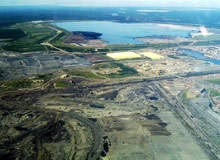
Recent times have been tough for oil sands producers, whose shares had been beaten down as crude prices skidded and projects suffered more cost overruns.
Three environmental groups quit a northern Alberta oil sands development advisory body that also includes government and industry representatives, saying it had lost legitimacy. Then reports surfaced that children had reeled in a fish with two jaws from a lake downstream from where tens of billions of dollars worth of projects are pumping synthetic oil.

Discover B2B Marketing That Performs
Combine business intelligence and editorial excellence to reach engaged professionals across 36 leading media platforms.
But by midweek, the mood changed. A stealth visit to Canadian Natural Resources' new Horizon oil sands mining project by two of the world's richest men, Bill Gates and Warren Buffett, overshadowed all.
Shares of such major players as Canadian Natural, Suncor Energy and Canadian Oil Sands Trust took off. Interest by the Microsoft co-founder and Berkshire Hathaway chairman was cited as a factor.
"They are some pretty astute guys; they've done fairly well. And for them to come up here and take a look, this is interesting," said William Lacey, an analyst with Calgary-based FirstEnergy Capital. "But it always surprises me, frankly, what gets a market going."
It has not been made public why Gates and Buffett toured the C$9.3bn (US$8.9bn) project north of Fort McMurray, Alberta. But local media trumpeted it as a show of support for oil sands development.
US Tariffs are shifting - will you react or anticipate?
Don’t let policy changes catch you off guard. Stay proactive with real-time data and expert analysis.
By GlobalDataThe industry and Alberta government had become used to being on the defensive over oil sands' impact on water, land and air quality and strains on local communities.
"I don't think that the Buffett-Gates visit changes too much on the environmental concern side," said Joseph Doucet, a professor of energy policy at the University of Alberta. "But I do think it is one more data point, suggesting the interest in investment in the oil sands continues to be there for many reasons that are not going to go away."
Such high-profile curiosity shows the need for the industry and government to better understand what the environmental and social costs are, Doucet said.
The tone has shifted
Until this year, the story of the oil sands, the largest deposit of crude oil outside the Middle East, centred on billions of dollars in investments, fast-growing production and Canada being a secure supplier to the huge US market.
But the tone shifted. Greenpeace, the Natural Resources Defense Council and other green groups have mounted an offensive to tell Canadians and Americans that development of Alberta's 'dirty oil' is worsening global warming, destruction of boreal forest and water pollution.
The battle reached a fever pitch in the spring when 500 ducks died when they landed on a Syncrude Canada Ltd tailings pond, a lake of toxic by-products from oil-sands processing.
by-products from oil-sands processing.”
Then, the mutated two-jawed fish from Lake Athabasca, downstream from the oil sands developments, made headlines after it was shown at a Keepers of the Water conference in the northern Alberta community of Fort Chipewyan. There, native elders have long said water pollution is behind a high incidence of cancer and other ailments. To date, there is no evidence tying the fish mutation to oil sands production.
In the face of environmental criticism, Alberta's government has launched a C$25m communications push to protect the province's 'brand' around the world, and explain that the oil sands are being developed responsibly.
The Canadian Association of Petroleum Producers started its own campaign to get out the message that oil sands firms are doing all they can to cut emissions, lower water use and limit damage to the northern forest, and are willing to discuss such issues with the public. This is why the uber-tycoons' interest is seen as so welcome, even if they have no immediate plans to invest.
"It may have been an interest thing, where they say 'Well, I've heard a lot about this and energy is a very important part of the world going forward. No matter what I invest in, I need to understand this'," Lacey said.


