

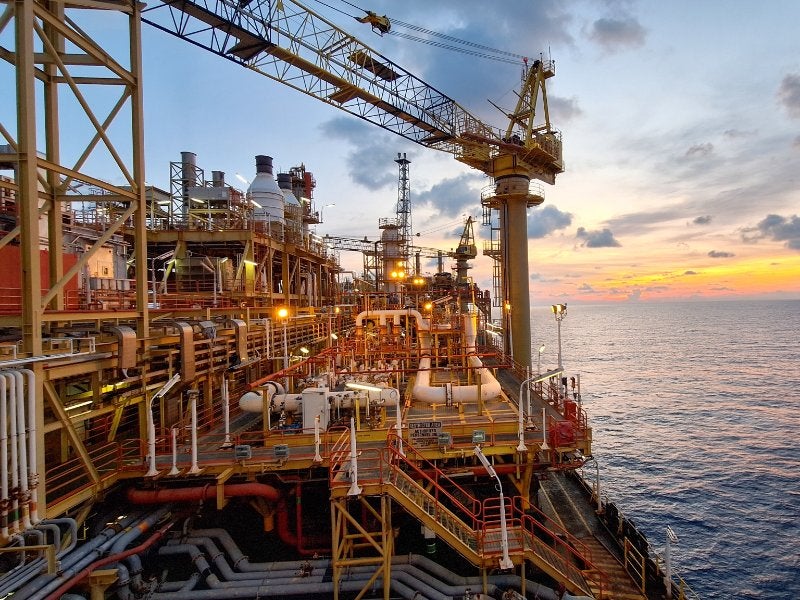

Hammerhead is an offshore oil project being developed on the Stabroek block, offshore Guyana.
ExxonMobil affiliate ExxonMobil Guyana holds a 45% interest in the Stabroek block under a petroleum agreement signed in 2016. The other joint venture partners include Chevron (30%) and CNOOC Petroleum Guyana (25%).
Recommended Buyers Guides

The final investment decision (FID) on the Hammerhead development was taken in September 2025, after securing necessary regulatory approvals. The project would entail an investment of $6.8bn.
Hammerhead would become the seventh sanctioned development on the 6.6-million-acre Stabroek block, which holds nearly 11 billion barrels of oil equivalent in discovered recoverable resources.
First oil from the development is anticipated in 2029. Production is expected to continue for at least 20 years, with a capacity of approximately 150,000 barrels of oil per day (bpd).
Hammerhead development location
The Hammerhead offshore development lies in the south‑central area of the Stabroek Block, approximately 160km offshore Georgetown, the capital of Guyana. The discovery sits in water depths of 1,000m.
Under the petroleum agreement, ExxonMobil subsidiary Esso Exploration and Production Guyana Limited (EMGL) secured government approvals for six projects on the Stabroek Block, namely Liza Phase 1, Liza Phase 2, Payara, Uaru, Whiptail and Yellowtail.
The petroleum agreement spans an area of 26,806km² and it was executed with a petroleum prospecting licence for the Stabroek Block.
The Hammerhead prospect forms part of the wider exploration and development programme within this block.
Discovery of the Hammerhead development
ExxonMobil discovered the Hammerhead oil deposit in August 2018, making it the company’s ninth oil discovery in the Stabroek Block.
The Hammerhead-1 well encountered approximately 197ft (60m) of high-quality, oil-bearing sandstone reservoir. The well was safely drilled to a 13,862ft (4,225m) depth in 3,773ft (1,150m) of water by the Stena Carron drillship.
The well is located approximately 13 miles (21km) south-west of the Liza-1 well within the Stabroek Block. The discovery followed earlier discoveries at Liza, Liza Deep, Payara, Snoek, and Turbot, among others.
Hammerhead project development plan
The Hammerhead development will use multiple dynamically positioned drill ships to drill 18 production and injection wells. After each well reaches total depth, the project team will complete the wells and install the subsea production system.
The subsea equipment will be installed in water depths of approximately 750m-1,200m. Key components of the subsea kit include production tree, production manifold, flowlines, risers, and umbilicals.
A subsea control system will monitor and operate the field, with control signals and power supplied from the Hammerhead floating production storage and offloading (FPSO) vessel via a control umbilical.
Produced fluids, including oil, gas and water, will flow from the wells through the subsea network to the FPSO vessel for processing.
The FPSO will separate oil, produced water and associated gas for onboard storage. Subsequently, the stabilised crude will be transferred to third-party shuttle tankers. The vessel will also treat produced water before discharge and will use treated seawater for cooling and injection to support pressure maintenance.
The development will minimise the routine flaring of associated gas. The FPSO will use gas as fuel and inject surplus gas into the reservoir to support oil recovery.
As reservoir pressure declines, the project may expand gas and/or water injection to maintain pressure and optimise hydrocarbon production.
ExxonMobil is also evaluating options to route gas to other fields within the Stabroek Block for enhanced recovery and/or to potential onshore outlets.
Hammerhead FPSO specifications
The Hammerhead FPSO vessel will operate in about 1,025m of water and feature SOFEC’s spread mooring system.
The FPSO is designed for an initial annual average oil production rate of 150,000bpd and will provide up to 1.6 million barrels of crude storage.
It will also have the capacity to re-inject up to 340,000 barrels of produced water per day for pressure support.
In addition to the processing equipment, the FPSO will include associated utilities and living quarters to support offshore operations personnel.
Contractors involved
In April 2025, Modec was awarded the contract by ExxonMobil Guyana to develop the FPSO vessel for the Hammerhead project. The company secured the full engineering, procurement, construction, and installation (EPCI) scope to develop the vessel in September 2025 following the FID.
Modec will also provide operations and maintenance services for the FPSO for ten years from first oil.
TechnipFMC won a contract, worth between $250m and $500m, to supply subsea production systems for the Hammerhead development.
The contract encompasses project management, engineering, and manufacturing of subsea production systems supporting both production and water injection capabilities.
Under a nearly $500m EPCI contract, Italian multinational oilfield services company Saipem will be responsible for the installation of subsea, umbilical, riser and flowline (SURF) structures for the production facility and the gas export system related to the development.
Saipem will carry out the subsea installation using a variety of construction and support equipment, including the Saipem FDS2 and the Shen Da. Project logistics will be executed and managed in Guyana through the Vreed-en-Hoop Shorebase (VEHSI) yard.
