

Canadian energy company Enbridge is advancing its Mainline Optimisation project, aimed at increasing transportation capacity across its Mainline pipeline network and the Flanagan South crude oil pipeline system (FSP).
The Mainline system carries around 30% of North America’s crude oil, moving up to three million barrels (mbbl) per day of light, medium and heavy grades from Alberta, Canada, into the US Midwest and eastern Canada.
Recommended Buyers Guides

The FSP is an interstate crude oil pipeline running from Enbridge’s Flanagan Terminal in Illinois to Cushing, Oklahoma.
The project is being undertaken in two phases, with the first phase including an estimated investment of $1.4bn
The final investment decision on the first phase of the project, Mainline Optimisation Phase 1 (MLO1), was taken in November 2025.
MLO1 is anticipated to commence operations in 2027.
MLO1 project details
Enbridge’s MLO1 project plans to add 150,000 barrels per day (bpd) of transportation capacity on the Mainline system and a further 100,000bpd on the FSP system, with the additional throughput targeted for 2027.
The work will combine improvement in operational changes upstream, along with terminal upgrades.
On the FSP system, the scope of work under the project includes adding pump stations and completing terminal modifications to support higher flows, alongside the use of available capacity on the Seaway Pipeline.
The FSP expansion is supported by long-term, take-or-pay agreements that provide an end-to-end service corridor from Edmonton, Alberta, to Houston, Texas. Most existing customers have also opted to extend their current full-path FSP contracts beyond 2040.
Mainline Optimisation Phase 2 project details
Mainline Optimisation Phase 2 is currently in the planning stage and is intended to deliver an additional 250,000bpd of incremental, full-path capacity on the pipeline system by the end of the decade.
The planned improvements for the second phase include utilising existing capacity on the Dakota Access Pipeline, in which Enbridge holds a 27.6% net interest, while expanding routing flexibility across the broader Mainline system.
Mailine pipeline network details
The Mainline system spans approximately 13,800km and comprises 20 major terminals, 200 tanks, 36mbbl of working tankage, 60mbbl of contracted storage capacity and 600 pump units, alongside 20 receipt points and 30 delivery points.
The network ships a mix of hydrocarbons including oil sands crude and natural gas liquids (NGLs), supplying refineries across the continent and linking western Canadian production with several key refining hubs.
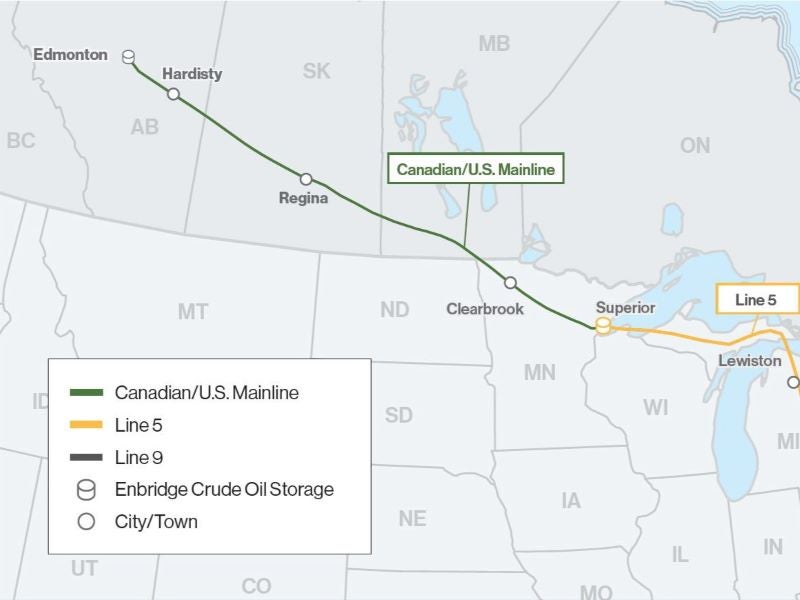
The Mainline network includes the Canadian Mainline, running from Edmonton to the Canada–US border at Gretna, Manitoba, and the Lakehead System, also referred to as the US Mainline, which continues to Clearbrook, Minnesota, and Superior, Wisconsin.
The crude is further delivered into markets across Indiana, northern Illinois, Michigan, Minnesota, Ohio and southern Ontario, with additional connecting pipelines providing access to demand centres including the US Gulf Coast, Oklahoma, southern Illinois and Quebec.
The first section of the Mainline system began with Line 1, built in 1950 to connect Edmonton with Superior following the Leduc discovery, and was expanded over subsequent decades with ongoing integrity and maintenance programmes.
Details of FSP and Seaway pipeline systems
The 954km, 36in diameter Flanagan South crude oil pipeline entered service in 2014. It runs parallel to Enbridge’s Spearhead Pipeline.
The Seaway Pipeline System includes two 846km, 30in pipelines running between Cushing and the Seaway Jones Creek Terminal in Brazoria County, Texas. From the terminal, crude can be routed to locations such as Freeport Docks, the Phillips 66 Sweeny Refinery, the Enterprise ECHO Terminal, the Enbridge Houston Oil Terminal and Texas City.
It also provides onward connections to Beaumont and Port Arthur, linking with the Sunoco Nederland terminal, Enterprise Beaumont Marine West and the Phillips 66 Beaumont facility.
