

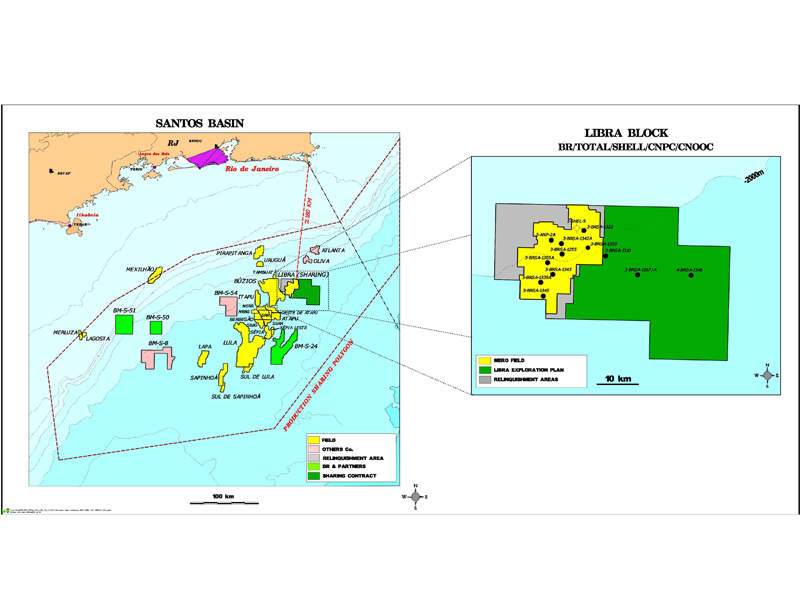
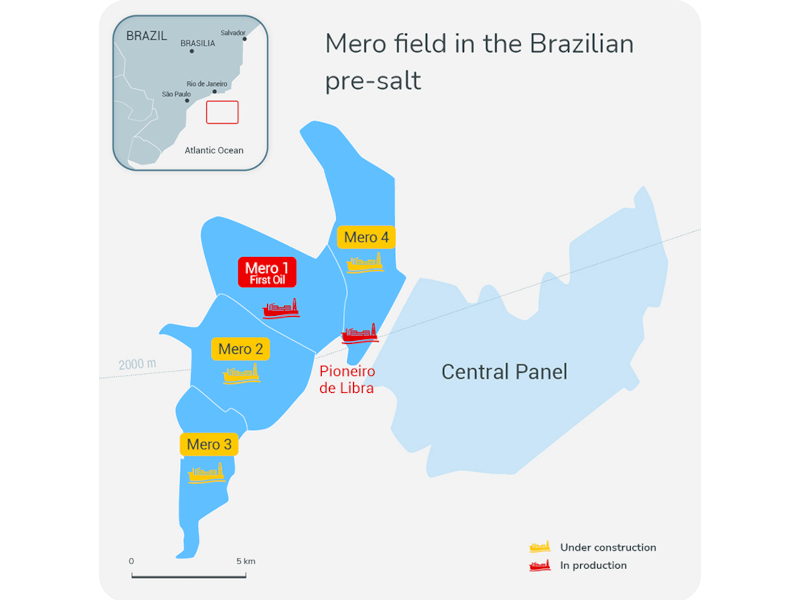
The Mero field is an ultra-deepwater oil field situated approximately 180km offshore Rio de Janeiro, Brazil, in the Libra block. It is located in the pre-salt area of the Santos Basin.
The field is owned by the Libra consortium, which is led by Petrobras (38.6%) and comprises Shell Brasil (19.3%), TotalEnergies (19.3%), CNPC (9.65%), CNOOC (9.65%) and Pré-sal Petróleo – PPSA (3.5%).
Recommended White Papers

Recommended Buyers Guides

Petrobras declared the commercial viability of the Mero oil field in November 2017.
First oil from the field’s first development phase, Mero-1, was achieved in April 2022.
In May 2025, Petrobras announced first production from the field’s fourth development phase, Mero-4.
Mero oil field discovery and reserves
The Mero oil field was discovered by the 2-ANP-2A-RJS appraisal well, drilled in 2010.
The drilling was conducted in the north-western part of the giant Libra block, as part of the Libra oil field appraisal.
A total of 12 appraisal wells were drilled to determine the commercial viability of the field. The wells discovered oil columns as thick as 410m.
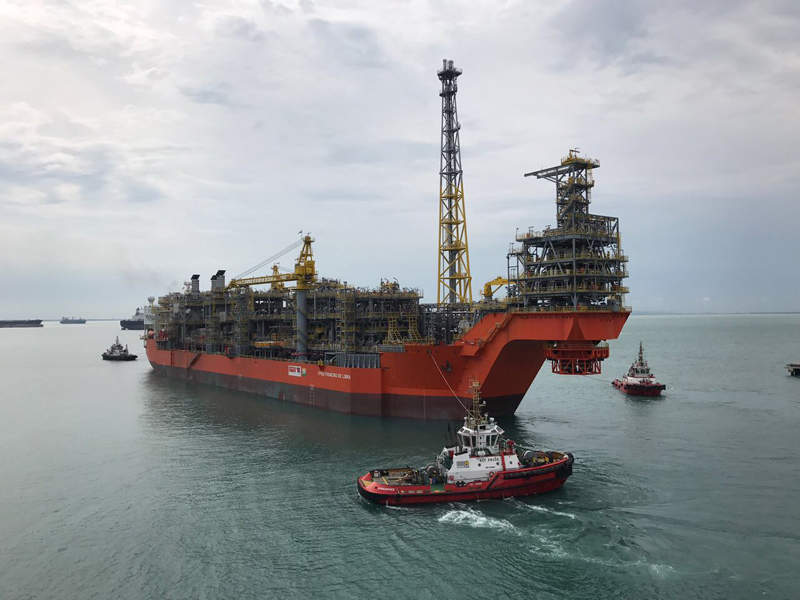
An extended well testing programme was carried out within the Mero 2 and Mero 3 areas using the Pioneiro de Libra floating production storage and offloading unit (PFSO).
The Mero oil field holds approximately 3.3 billion barrels of oil equivalent (boe) in high-quality, high-yield carbonate reservoirs.
Mero oil field development details
The Brazilian oil field is divided into four areas: Mero 1, Mero 2, Mero 3 and Mero 4, which are all being developed separately.
As the project is being developed in four phases, it involves the development of four FPSO units to produce and process the oil extracted from the wells in each respective area.
Each FPSO has an operational capacity of 180,000 barrels of oil equivalent per day (boed) as well as 12 million cubic metres a day of gas.
The project will implement Petrobras’ high-pressure separation technology, known as HISEP, which is scheduled to become operational in 2028.
The unique technology aims to segregate carbon dioxide (CO₂)-rich gas from oil for reinjection into the seabed, which will reduce the amount of gas entering the FPSOs while enhancing oil production as well as the field’s efficiency.
Details of Mero-1
The Mero-1 project, which is the first definitive production system of the field, covers the development of 17 interconnected wells. Six producing wells and seven injectors were initially linked to the FPSO.
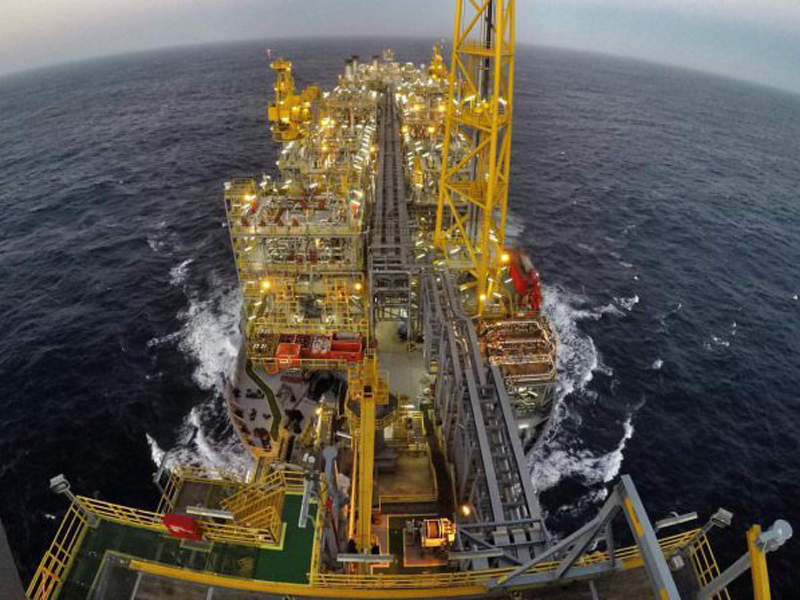
Named Guanabara MV31, the FPSO is operated by MODEC. It has a water injection capacity of 225,000 barrels a day and storage capacity of 1.4 million barrels of crude oil. Deployed at a water depth of 1,930m, 150km off the coast of Rio de Janeiro, the unit features a spread mooring system.
The FPSO is integrated with a gas reinjection system to maintain pressure and enhance oil recovery. Mero-1 is also part of a carbon capture, utilisation and storage project.
Mero-2 details
The final investment decision (FID) for the development of the second phase of the Mero project (the Mero-2 project) was announced in June 2019. The project is being operated through the FPSO Sepetiba.
Commencement of production from the second phase of the field was announced in January 2024, increasing the production capacity of the field to 410,000 barrels of oil per day (bpd).
The FPSO Sepetiba has a water injection capacity of 250,000 barrels a day and storage capacity of 1.4 million barrels of crude oil ,and is moored at a water depth of 2,000m.
It is owned by SBM Offshore (SBM, 64.5%), Mitsubishi (20%) and Nippon Yusen Kabushiki Kaisha (15.5%).
Mero-3 details
Production from the third phase of the Mero development (Mero-3) commenced in October 2024 via the FPSO Marechal Duque de Caxias.
The production unit is located at a water depth of 2,200m in the Libra block of the Mero oil field, 180km off the coast of Rio de Janeiro.
Mero 3 comprises 15 wells and is designed for a production capacity of 180,000bpd. The development incorporates measures to curb greenhouse gas emissions, including the reinjection of associated gas into the reservoir and the avoidance of routine flaring.
The wells are connected using subsea infrastructure consisting of fixed production and injection ducts, control umbilicals and flexible service ducts.
Following the start-up of Mero 3, total output capacity across the Mero field has increased to 590,000bpd.
Mero-4 details
The FID for the fourth phase of development (Mero-4) was taken in August 2021.
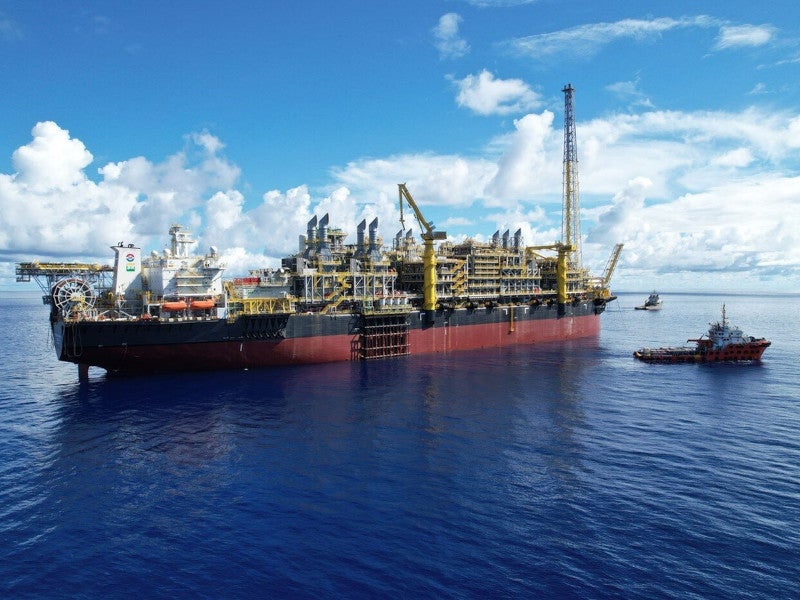
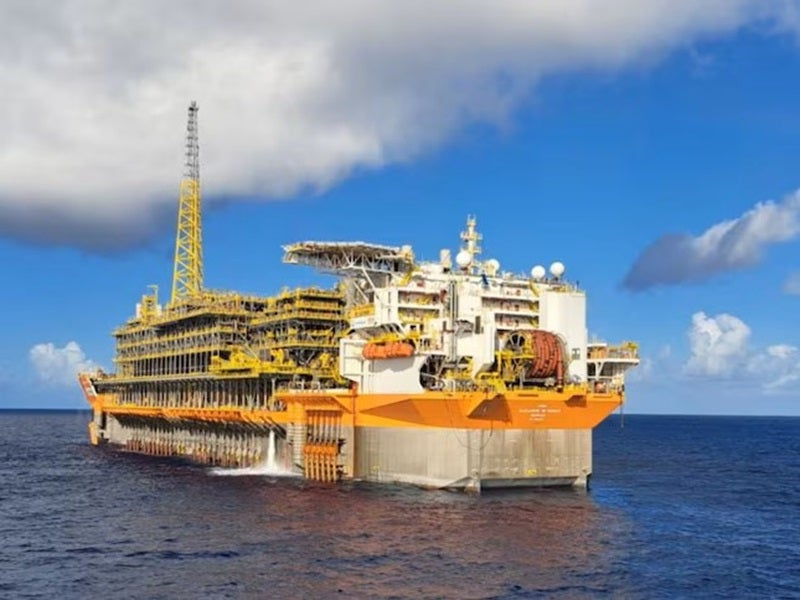
This phase links a dozen production wells to the Alexandre de Gusmão FPSO, which is designed to process up to 180,000bpd.
FPSO Alexandre de Gusmão is deployed 160km off Arraial do Cabo, Rio de Janeiro. It has been configured to limit greenhouse gas emissions by reinjecting associated gas back into the reservoir, avoiding routine flaring.
With the latest unit on stream, overall installed capacity at Mero has risen to 770,000bpd.
Contractors involved
Japan-based MODEC received a contract for the engineering, procurement, construction, mobilisation, installation and operation of the Mero-1 FPSO in December 2017.
The company also provided the topsides, processing equipment, hull and marine systems for the development. The FPSO is operated by the company and chartered for 22 years.
In April 2021, Jumbo Maritime awarded a contract to Fugro to provide support for the installation of 35 subsea torpedo piles and 24 mooring lines for the Mero-1 project.
Petrobras entered a contract with SBM for the lease and operation of the second platform, FPSO Sepetiba, in December 2019. In the same month, SBM formed a joint venture (JV) with Mitsubishi and Nippon Yusen Kabushiki Kaisha for the charter, operation and maintenance of FPSO Sepetiba.
SBM was awarded another contract for the charter and operation of the FPSO Alexandre de Gusmão in November 2021.
In August 2020, MISC Berhad signed a letter of intent to offer charter and operation services for the FPSO Marechal Duque de Caxias for the Mero-3 project. The vessel is chartered for 22.5 years.
Subsea 7 was engaged to provide engineering, fabrication, installation and pre-commissioning of 80km of risers and flowlines, 60km of flexible service lines, 50km of umbilicals, and associated infrastructure for the Mero-3 project in May 2021. The company was also responsible for installing the FPSO mooring lines and hook-up.
TechnipFMC received a contract for the engineering, procurement, construction and installation (EPCI) for the Mero-2 project in August 2020. The contract follows a previous contract awarded for all rigid lines for Mero-1 in February 2019.
Aker Solutions was contracted to provide a subsea production system and associated services for Mero-4 in November 2021. The company had previously received a similar contract for Mero-1 in 2018.
Other contractors and suppliers involved in the project are Benthic, Blue Marine Telecom, DOF Subsea, Geospace Technologies, Maersk Supply Service, Ocyan, Siemens Energy, SOFEC, Teekay Offshore, Tenaris and TMC Compressors.
