

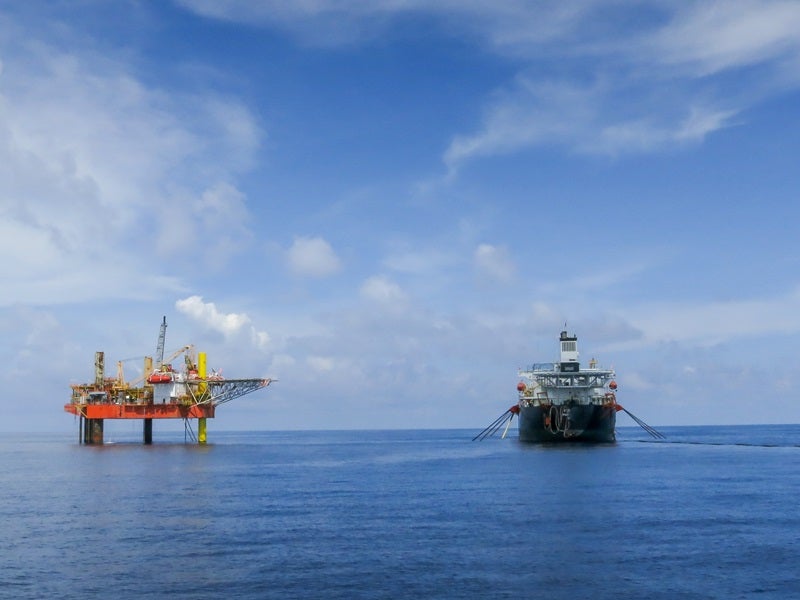
The Seme offshore oilfield is situated in the Block 1 licence offshore Benin, West Africa.
It is being redeveloped by Petroleum Benin, a wholly owned subsidiary of Akrake Lime Petroleum Holding (Akrake) and an indirect subsidiary of Rex International Holding.
Recommended Buyers Guides
The oilfield was discovered by Union Oil in 1969 and first developed by Norwegian oil company Saga Petroleum, which produced an estimated 22 million barrels between 1982 and 1998. Output was halted in 1998 amid weaker oil prices.
In December 2023, a production sharing contract (PSC) for the Block 1 licence was signed between Akrake, the Government of Benin and Octogone Trading, an integrated energy and commodities company.
Akrake serves as the operator of the PSC with a 76% working interest, while the Government of Benin holds 15% and Octogone Trading holds the remaining 9%.
The redevelopment of the Seme field is intended to restart production and improve recovery using horizontal wells and modern completion methods designed to manage water more effectively.
Development is being undertaken in two phases, with first-phase production expected to commence in 2026.
Project location
The field sits within the Block 1 licence in the north-eastern part of Benin’s offshore sedimentary basin, in water depths of roughly 27–54m.
The licence covers approximately 551km2 and lies around 2.5km from the Benin–Nigeria border.
Geology and reserves
The Seme field holds hydrocarbons in multiple oil pay zones in the Abeokuta (H6) and Albian (H7 and H8) sandstones.
The H6 reservoir was previously produced; however, the H7 and H8 reservoirs have never been developed.
As of December 2024, the field was estimated to contain 10.9 million stock tank barrels (mstb) of 2P reserves.
Seme field development plan
The Seme field is set to be developed through a production system comprising a drilling platform, the Stella Energy 1 mobile offshore production unit (MOPU) and the Kristina floating storage and offloading unit (FSO), which are already in the final stages of installation at the field.
The phase one field development plan includes the drilling of a vertical exploration and appraisal well to penetrate the H7 and H8 reservoirs, followed by a horizontal development well (AK-1H) in H6.
This phase also includes the drilling of a second horizontal well (AK-2H) in the H6 reservoir.
Phase two redevelopment will focus on the deeper H7 and H8 intervals, with the potential development of three oil wells targeting H7 and two gas wells targeting H8.
This phase will begin with the H7 development, which will use three horizontal wells with fish bone completions and electric submersible pumps.
First oil from H7 is targeted for the first quarter of 2027 (Q1 2027), with these wells scheduled to be drilled consecutively alongside the second H6 phase one development well.
In parallel, an additional exploration well is planned in Block 1, outside the current North Sèmè field area.
The next stage of phase two will focus on H8, with two horizontal wells using fish bone completions.
This phase also includes adding wet gas processing facilities on the MOPU and laying a pipeline to shore.
An onshore gas processing plant is planned to provide domestic gas for a power station, with first gas expected in Q1 2029.
Drilling activities at Seme oilfield
Akrake spudded the first well (AK-1H) in August 2025 using the Borr Gerd jack-up rig as part of a 100-day, three-well programme.
The drilling plan includes two horizontal producer wells, AK-1H and AK-2H, targeting the H6 interval, which has been developed previously, and AK-1P, a deeper vertical appraisal well to collect data from the H7 and H8 reservoirs to support a potential second phase.
In February 2026, Akrake announced the completion of drilling at the AK-2H production well. The well includes a 1,405m horizontal section through the reservoir, with around 950m drilled in oil-saturated sandstone of the H6 reservoir.
The remaining interval comprises non-reservoir shale, and no water-bearing sands were encountered.
The well was geo-steered using logging-while-drilling tools to stay within oil-bearing sands. Reported reservoir properties were broadly in line with expectations, including average porosity above 19% and average oil saturation above 70%.
The reservoir section, now completed, has been fitted with screens and autonomous inflow control valves to help limit sand production and reduce water influx. A downhole electrical submersible pump is being installed above the screens.
Contractors involved
Borr Gerd was contracted in April 2025 for a 120-day drilling campaign using its modern jack-up rig.
The independent summary qualified person’s report for the field was prepared by Exceed Torridon.
Tetra Tech RPS Energy prepared the competent person’s report for the Seme oilfield.
