

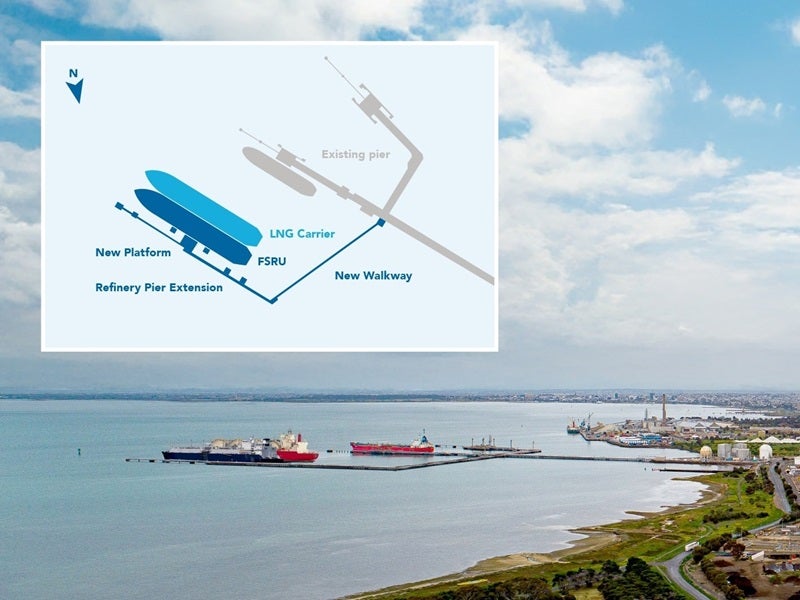
The Viva Energy Hub Gas Terminal is a proposed liquefied natural gas (LNG) import terminal planned to be developed in Geelong, Victoria, by Viva Energy Australia.
The project is designed to improve energy security and supply flexibility for south-eastern Australia. It will allow excess volumes to be exported to South Australia, New South Wales and Tasmania through the established pipeline network.
Recommended Buyers Guides

The terminal will also help maintain a secure supply for the more than two million Victorian households and 65,000 businesses that depend on gas for everyday use and operations.
In May 2025, the Victorian government issued a favourable assessment of the project’s Environmental Effects Statement (EES).
Operations are expected to commence in 2028, with a projected lifespan of 20 years.
Location of the Viva Energy Hub Gas Terminal
The Viva Energy Hub Gas Terminal will be located at Geelong refinery Pier in Corio Bay, in the Greater Geelong City, 75km (46.6 miles) south-west of Melbourne, Australia.
It will form a core element of Viva Energy Australia’s broader Energy Hub at Geelong, which includes the company’s existing refinery on the same site.
Viva Energy terminal details
The Viva Energy Hub Gas Terminal will include a floating storage and regasification unit (FSRU), an associated gas treatment plant, an extension to the existing refinery pier and a new connecting pipeline.
To accommodate the FSRU and visiting LNG carriers, the existing pier will be extended by approximately 570m. Additionally, selective dredging is planned to ensure sufficient depth and manoeuvring space for safe vessel berthing and departure.
LNG for the terminal will be sourced from both domestic and international suppliers and delivered to the FSRU by LNG carriers.
Once on board, the LNG will be stored and regasified before being transferred to a treatment plant within the refinery area, where odorant and nitrogen will be added as needed to comply with national gas quality standards. The processed gas will then flow through a new pipeline into the Victorian Transmission System.
The terminal is expected to deliver more than 120 petajoules of gas a year, providing a significant new supply source for the regional market.
At full capacity, the terminal could send out up to 750 terajoules of gas a day, offering greater flexibility to meet both daily and seasonal demand fluctuations in Victoria and the broader southern market.
Gas terminal pipeline details
The planned gas pipeline will span approximately 7km and have a maximum diameter of 600mm.
It will comprise two main sections. The first section is an aboveground stretch of approximately 3km that will connect the FSRU to the treatment facility, and the second section is an underground line of approximately 4km that will link to the Victorian Transmission System at Lara.
Where possible, the underground section will follow existing easements or licensed road reserves managed by Viva Energy, aligning with current pipeline corridors to minimise additional land disturbance.
Construction of the underground portion will use specialised trenching equipment and will be scheduled to align with existing land use patterns. Trenchless installation methods will be used in areas that are technically challenging or environmentally sensitive.
The aboveground segments of the pipeline will be supported by pipe racks along the jetty and within the refinery site.
Viva Energy Gas Terminal project benefits
The project will help in enhancing price competition across the East Coast in a market that is otherwise highly concentrated, by allowing access to competitively priced gas from Australia and international sources.
It will create a direct connection between the Victorian market and major supply basins in northern Australia, strengthening sovereign supply security.
The project will also help in delivering gas closer to where it is consumed, increasing overall capacity within Victoria’s gas transmission system and reducing the need for costly new large-scale pipelines and storage infrastructure.
It will facilitate the energy transition by maintaining adequate gas supplies for power generation as coal-fired capacity is phased out and during periods when renewable output is low.
Furthermore, the FSRU may operate for as long as market demand persists, and once gas demand is no longer sufficient, it can depart the terminal, and the jetty can be repurposed.
Contractors involved
In March 2025, Viva Energy appointed Poten & Partners, a provider of advisory, shipping and commodity brokerage, and business intelligence services, to secure an FSRU for the planned terminal.
Under the mandate, Poten & Partners invited expressions of interest from the international shipping market to either provide an existing FSRU or undertake the conversion of an LNG carrier into an FSRU for deployment at Geelong.
