
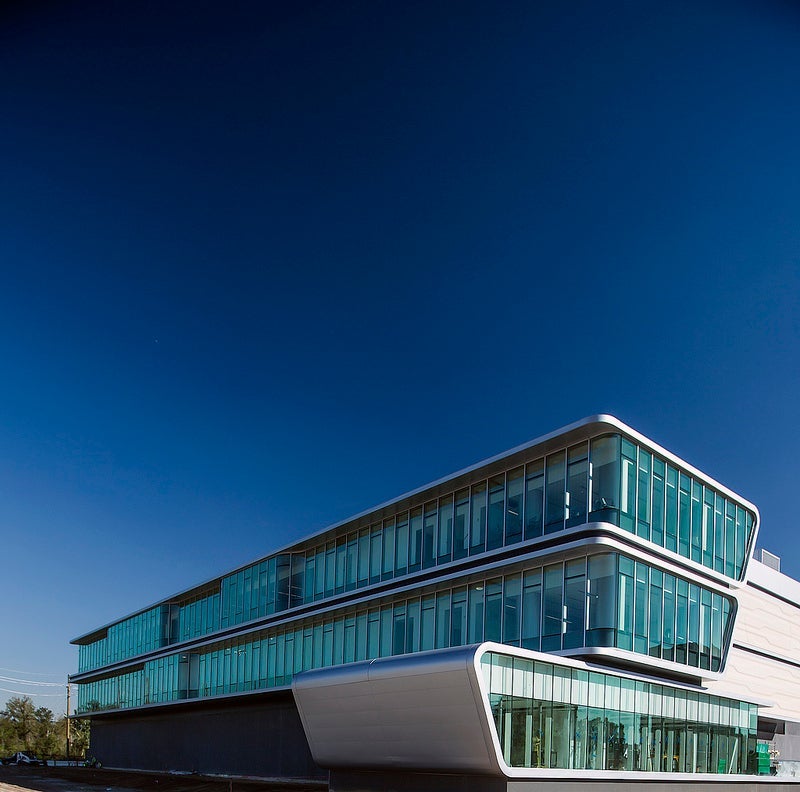
In a bid to support its global oil and gas business, BP has opened a new centre for high-performance computing at its US headquarters in Houston, US, to house a supercomputer for commercial research.
The centre aims to serve as a worldwide hub for processing and managing geophysical data from across the company’s portfolio. It will also provide new possibilities for research into other important aspects of BP’s business activities ranging from oil refining to oil recovery.

Discover B2B Marketing That Performs
Combine business intelligence and editorial excellence to reach engaged professionals across 36 leading media platforms.
According to BP, the centre will help facilitate its development of new ‘digital rocks’ technology for calculating petrophysical rock properties and modelling fluid flow directly from high-resolution 3D images.
BP upstream technology head Jackie Mutschler said: "BP’s investment in this new supercomputing centre not only highlights the increasingly high-tech nature of today’s global oil and gas industry, it underscores our company’s long-held belief in the vital role technology plays and will continue to play in solving the world’s biggest energy challenges."
Housed in a three-storey, 110,000ft² building at the company’s Westlake campus, the new facility has been built to withstand Gulf coast weather events.
The building, which also reduces energy consumption and accommodates future growth, replaces BP’s previous supercomputing complex, which had been located within an office tower at the campus.
US Tariffs are shifting - will you react or anticipate?
Don’t let policy changes catch you off guard. Stay proactive with real-time data and expert analysis.
By GlobalDataWith the help of new computing power, speed and storage capacity, precise images of the subsurface can be obtained, improving the company’s ability to find new energy resources. This is achieved by reducing the time needed to analyse massive quantities of seismic data and enabling detailed in-house modelling of rock formations prior to commencement of drilling.
BP worked with HP and Intel to grow its computing power to over 2.2 petaflops, almost doubling its capability in 2013. The new supercomputer has a total memory of 1,000 terabytes and disk space of 23.5 petabytes.
Image: BP’s new Center for High-Performance Computing in Houston, US. Photo: courtesy of BP p.l.c.



