
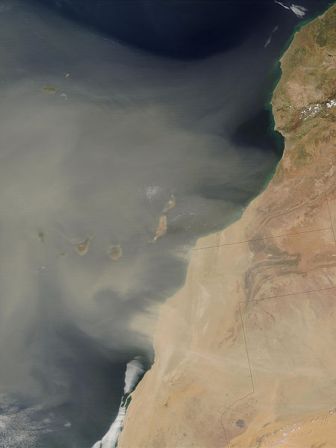
The Spanish and Moroccon governments have announced that they will carry out oil exploration activities in fields situated near the Canary Islands.
Both governments are moving forward with exploration activities despite the plan being opposed by the tourism industry and environmentalists in the Spanish archipelago.

Discover B2B Marketing That Performs
Combine business intelligence and editorial excellence to reach engaged professionals across 36 leading media platforms.
Oil exploration projects have been authorised by both governments in the area, even though there is no clarity about the maritime boundaries between the countries, reports IANS.
The nations have established territorial limits by creating an imaginary line, which will allow them to maintain equal distance between the Moroccan coast and the Canary Islands that belong to Spain.
The fields in the area are expected to hold around 1.4 billion barrels of petroleum and produce 140,000 barrels per day (bpd) of crude, which will help Spain meet 10% of its daily demand for oil, according to Spanish oil company Repsol.
Morocco said Scotland-based oil company Cairn Energy is planning to commence exploration work in the blocks in the next few weeks, which are situated next to those granted by the Spanish government to Repsol, and are around 60km from Lanzarote and Fuerteventura.

US Tariffs are shifting - will you react or anticipate?
Don’t let policy changes catch you off guard. Stay proactive with real-time data and expert analysis.
By GlobalDataThe Cajun Express rig, which is leased by Cairn Energy, is expected to start operations in early October. It is located around 555km northeast of the Canary Islands.
Repsol, which plans to work with RWE of Germany and Woodside of Australia, still needs to complete the environmental review process.
Some residents in the area, whose economy is dependent on tourism, are worried about the possible effects of an oil spill. Others contend that the energy industry will create jobs in the region and bring down the unemployment rate by around 33%.
Image: Canary Islands. Photo: Courtesy of NASA.



