
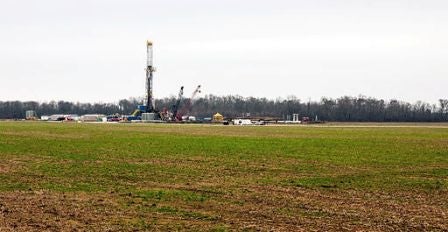
Fracking is not an important cause of earthquakes that can be felt on the surface, according to new research published in the Journal of Marine and Petroleum Geology this week.
Fracking, or hydraulic fracturing, is carried out to recover oil and gas which is tightly bound to rock formations and cannot be retrieved through normal drilling.

Discover B2B Marketing That Performs
Combine business intelligence and editorial excellence to reach engaged professionals across 36 leading media platforms.
Researchers from Durham University’s Energy Institute said that pumping of fracking liquid can reactivate dormant fault lines and that it is not a significant source of tremors compared to many other human activities, such as mining or filling reservoirs with water, reported the BBC.
During fracking, a mixture of water, sand and chemicals are pumped underground at high pressure to crack open sedimentary rocks and to release the fuels present inside.
Durham University Energy Institute Professor, Richard Davies, said hydraulic fracturing is not a significant cause for seismicity and that it is also fundamentally not important as mining or filling dams, which includes greater volumes of fluid.
"Most fracking related events release a negligible amount of energy roughly equivalent to, or even less than someone jumping off a ladder onto the floor," Davies added.

US Tariffs are shifting - will you react or anticipate?
Don’t let policy changes catch you off guard. Stay proactive with real-time data and expert analysis.
By GlobalDataThe researchers also said that so far there are only three incidents of earthquakes caused by fracking, one each in the US, the UK and Canada.
In 2011, a seismic activity related to underground injection of oil-drilling waste water created a 5.7 magnitude earthquake in Oklahoma, while the biggest, with a magnitude of 3.8, occurred at Horn River Basin in Canada in 2011.
According to the research, the effect of fracking can be reduced by not drilling close to tectonic faults.
Davies noted that by using 3D seismic imaging, the problems related to fracking could be identified and the risk of quakes can be avoided.
Image: Fracking on the Haynesville Shale near Shreveport, Louisiana, US. Photo: Courtesy of Daniel Foster.



