

The Mars field is located in the Gulf of Mexico approximately 209.2km south-east of New Orleans, US. The discovery well was drilled on Mississippi Canyon block 763 using the drillship Discoverer Seven Seas.
Data from four other wells and six sidetrack wells was used, together with 3D seismic work, to make the necessary development decisions.
Recommended White Papers

Recommended Buyers Guides

Shell Deepwater Production is the field’s operator and has a 71.5% interest. The remaining 28.5% interest in the Gulf of Mexico field is held by BP.
Mars oil field development
The initial development was designed to recover about 500 million barrels of oil equivalent (Mboe). The cost of the development for the initial project phase was approximately $1bn.
Out of the total project cost 55% was dedicated to the fabrication and installation of the hull, deck facilities and pipelines. The remaining 45% was spent on drilling and completing the wells.
Ten tension leg platform (TLP) development wells were predrilled with George Richardson, a Sonat semisubmersible rig. The contract rig H&P 201 was installed on the TLP to drill the remaining wells.
Mars field Tension leg platform
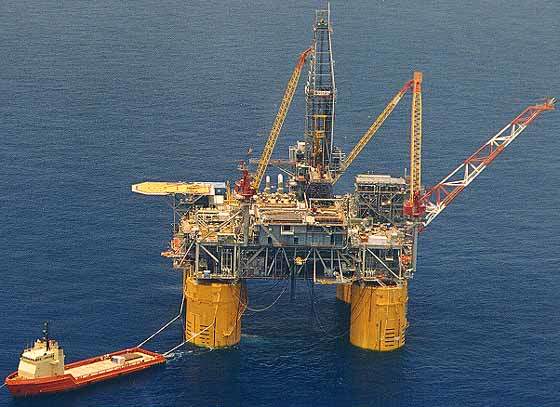
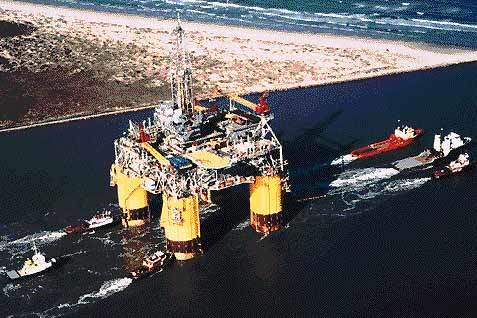
Mars’ TLP is 3,250ft-high from the seafloor to the crown block of the drilling rig, and its steel weight is approximately 36,500t. The TLP was designed to withstand hurricane force waves of 71ft and winds of 140mph, simultaneously.
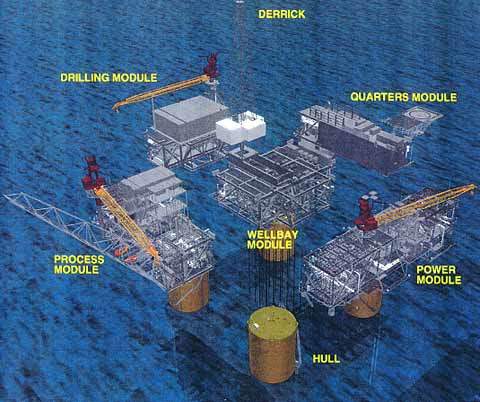
The hull comprises four circular steel columns, which are 66.5ft in diameter and 162ft-high, and four pontoons, 27ft-wide and 24ft-high, which connect the bottoms of the four columns. It weighs approximately 15,650t. The fabrication of the hull was completed by Belleli of Taranto, Italy.
The deck is composed of five modules, namely the wellbay, living quarters, processing, power and drilling. It has an open-truss framing design, which is 245ft x 245ft x 45ft and weighs approximately 7,200t. The fabrication of the modules was completed by McDermott.
The platform was closed temporarily in the first quarter of 2005 due to a planned replacement of flexjoints on both its oil and natural gas export lines. The TLP was also affected by Hurricane Katrina and production was stopped temporarily in 2005. Production resumed in April 2006.
In September 2010, Shell announced plans to add a second TLP, Mars B Olympus, about 130 miles south of New Orleans in approximately 3,100ft of water to extract production from eight Mississippi Canyon blocks: 762, 763, 764, 805, 806, 807, 850 and 851. First oil production from Olympus was achieved in January 2014. The Mars B TLP, which has a production capacity of approximately 100,000 barrels of oil equivalent a day (boe/d), will extend the field’s life to at least 2050.
Olympus features a self-containing drilling rig and 24 well slots, with the potential for subsea tie-backs. The Mars B development also includes subsea wells at the West Boreas and South Deimos fields, export pipelines, and a shallow-water platform at West Delta 143.
In October 2010, Dril-Quip won a $27m contract to supply subsea equipment for the Olympus TLP.
Tendons / piles
There are 12 tendons, three per corner, each with a 28in-diameter and a wall thickness of 1.2in.
Each tendon is approximately 2,852ft-long and the total weight for the 12 tendons is 6,150t.
The tendons are connected directly to piles in the seafloor. There are 12 piles, each 84in in diameter and 375ft-long, weighing 260t. The piles and tendons were fabricated by Aker Gulf Marine at its yard in Ingleside, Texas, US.
Drilling and production topsides
There are 24 well slots and a subsea well is tied back to the TLP, which includes complete separation, dehydration and treatment facilities. The accommodation module houses 106 people, a control room, and an emergency response centre.
Integration and installation
The integration contract was awarded to Aker Gulf Marine of Ingleside, Texas. This included module setting and interconnecting steel, piping, electrical and instrumentation.
The integration was completed during the second quarter of 1996. The contract for the installation of the TLP was awarded to Heeremac in May 1996.
Mars oil and gas field production
Mars was the largest Gulf of Mexico discovery in more than 25 years. Its daily production averages about 21,000 barrels of oil and 25 million square feet of natural gas.
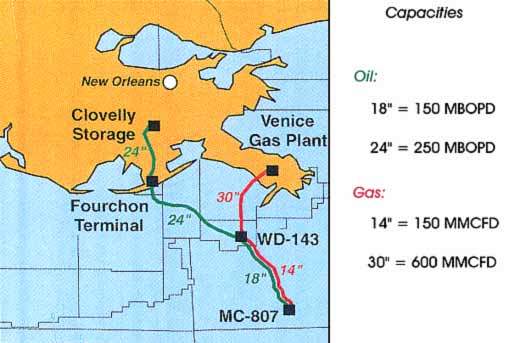
Oil is transported 116 miles to the shore in the $135m Mars Pipeline system, which was initially capable of handling 250,000boepd, with expansion plans of up to 500,000bpd.
The Mars Pipeline system consists of an 18in line extending from the TLP, about 40 miles to West Delta block 143, where it connects with a 24in line that comes ashore 55 miles away in Fourchon, South Louisiana.
From there, the line parallels the Louisiana Offshore Oil Port (Loop) pipeline about 29 miles to Loop’s Clovelly storage facilities, where the oil will go into a dedicated three million barrel salt dome cavern, which can feed any of five major interconnecting pipelines serving the national refining market.
