

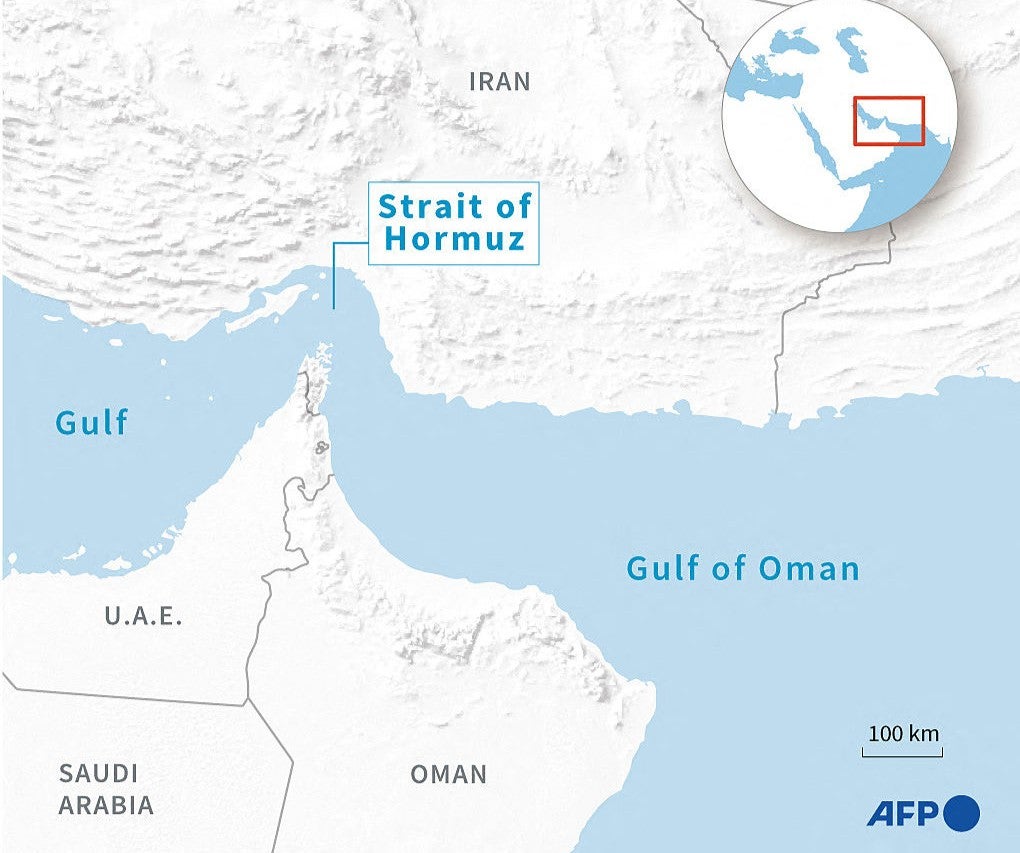
The Persian Gulf countries produce approximately 30% of global crude oil supplies and 17% of natural gas. Almost all of this production is transported via the Strait of Hormuz – the narrow waterway that separates the Arabian Peninsula from Iran.


That was until 2 March, when Iran effectively closed the strait in response to US and Israeli strikes. Since then, the closure – and the resultant petroleum product supply constraints – has been compounded by the US naval blockade on Iranian ports.
The strait’s closure will spark “a paradigm shift”, according to Rinaldo Brutoco, founder and president of the World Business Academy think tank.
“We are victims of international fossil fuel mechanisms that are dependent upon extraordinarily unstable regions of the world. They present supply chain issues that are insurmountably difficult,” he says.
The Iran-US conflict remains unresolved and while peace talks are ongoing, a deal is certainly not imminent. In the interim, long-relied-upon supplies of oil from the Gulf nations are being curtailed, and the world is heading towards a summer of oil shocks, with major ramifications for economies across the globe.
Not all supply chains are equal, however, and some players are feeling the weight of the conflict more heavily than others.
Production in the Gulf: oil and gas supplies pre-conflict versus now
Iran
Under pre-conflict conditions, Iran produced between 4% and 5% of global oil trade. Its exports sat between 1.5 and 1.7 million barrels per day (mbbl/d) in 2025 – equating to roughly 10% of all oil passing through the strait. Until April, this picture remained largely unaffected as the closure of Strait of Hormuz was controlled by the Iranians and Iran-flagged oil tankers were allowed to pass.
That was until the US initiated a retaliatory blockade on Iranian ports on 13 April, following the collapse of peace talks. Since then, the US Central Command has reportedly redirected 108 commercial vessels.
Yet the blockade has only curtailed Iranian oil exports and tens of millions of barrels of Iranian oil have reportedly bypassed the blockade using Iran’s ‘dark fleet’. In April, both the Hero II and Hedy large crude carriers reportedly left Iran, potentially carrying up to 4mbbl of oil to importers via the Arabian sea.
Iran is also looking for storage solutions to avoid cutting production. It is turning to ageing, anchored tankers to boost capacity, but even the most generous estimates place its floating storage volume at 75mbbl.
However, the blockade already appears to have had some impact and Iran has reportedly reduced its production. Precise figures are difficult to determine, but US Energy Secretary Chris Wright asserted the reduction amounted to 400,000 barrels per day.
The broader Middle East
Many of Iran’s Middle Eastern neighbours have experienced bigger blows to production as, without export, storage becomes an insurmountable obstacle, with knock-on effects for production.
“Production is the second line impact: if you can’t ship the oil out, then oil piles up and production has to stop,” explains Daniela Hathorn, senior market analyst at Capital.com. “That is when the conflict gets more complicated, because it is not that easy to just restart all of the operations again.”
Pre-conflict, almost a third of global seaborne oil trade passed through the Strait of Hormuz. Of the crude oil exports, around 37% came from Saudi Arabia, 22% from Iraq, 12.9% from the United Arab Emirates (UAE), 10% from Iran and 4.4% from Qatar.
Paul Hasselbrinck, lead analyst at Offshore Technology’s parent company GlobalData, identifies Iraq, Kuwait and Bahrain as being “highly affected” by the conflict, noting that “Iraq has suffered the biggest percentage drop in oil revenue as a result of the effective closure of the strait, lacking meaningful alternative routes to export”.
Indeed, Iraq’s oil production has collapsed to around 1.39mbbl/d from an average of 4.1mbbl/d in the three months prior to the conflict. Elsewhere, the UAE has reduced its oil production by around 44%, Bahrain by around 30% and Kuwait by 20–25%. Saudi Arabia – the world’s biggest oil exporter – has also cut oil production by 20%.
The picture is similarly dire for liquefied natural gas (LNG). Around 19% of global LNG trade is transited through the strait, including roughly 93% of Qatar’s exports and 96% of the UAE’s. Qatar was the second-biggest LNG exporter globally after the US; however, following strikes on QatarEnergy’s Ras Laffan facility, the national oil company (NOC) ceased all LNG production. Experts suggest it could take up to five years to repair the damage to the affected trains.
Infrastructure damage has been another significant cause of production losses. Parts of the South Pars gas field (shared by Iran and Qatar) were hit by Israeli airstrikes in March and April 2026, while Bahrain’s NOC, Bapco Energies, was forced to declare force majeure on its group operations after a fire broke out at its Sitra refinery, sparked by an Iranian strike.
Saudi Arabia is exporting some oil
Gulf nations have long been aware of the vulnerability the chokepoint represents, and Saudi Arabia in particular has prepared for the risks posed by geopolitical volatility. The East-West crude oil pipeline (Petroline) was built in 1981, specifically to bypass the Strait of Hormuz during the Iran-Iraq war, when the strait had become a highly volatile, militarised chokepoint – a pertinent description.
The East-West oil pipeline has a maximum capacity of 7mbbl/d and has served as a partial safety net for Saudi Arabian oil. Pre-conflict, it was used to transport around 1.6mbbl/d, but the pipeline reached full capacity in late March 2026 (5mbbl/d is exported via Yanbu, while 2mbbl/d is provided to domestic Red Sea facilities).
As a result, Saudi Arabia has been the least affected of the Gulf producers. However, that is not to say that the impact of the conflict has not been significant. Saudi Arabia previously transported 80% of its crude through the strait; its closure has seen exports drop from 10.822mbbl/d in February to 8mbbl/d in March.
“Saudi oil will come out through the Red Sea until they can rebuild their pipeline structure to take more oil out through that back door to the Red Sea, and a spur line that could exit through Egypt or another port on the Mediterranean”, says Brutoco. Looking ahead, he adds: “That realignment is one you can see happening in the relatively near future, because you can put that enhanced pipeline in within a year or two. However, you still have to close the wells down for now.”
Without the Gulf, oil supplies are strained: the import picture
Asian buyers
The biggest importers of Middle Eastern oil were in the Asia-Pacific region. China, in particular, was a major purchaser of Iranian oil.
“Data prior to the conflict was suggesting that around 80–85% of the oil coming from the Gulf and passing through the Strait was going to Asia,” comments Hathorn. “The biggest importer was China, with about 37% of that as of the end of 2025. India was another big importer, as well as South Korea and Japan.”
According to shipping analytics company Kpler, Asian markets imported 14.74mbbl/d of Middle Eastern crude oil in 2025 – 60% of the region’s overall imports. The bottleneck has rocked energy security across the board, but Japan and South Korea have been particularly shaken, with Middle Eastern crude comprising 95% and 70% of their imports, respectively.
China has long been deliberate about diversifying its imports in order to ensure energy security, not taking more than 20% of its requirements from a single supplier. However, with so many suppliers out of the equation, China’s imports are technically down by around half – it sourced approximately 5.4mbbl/d of its 11mbbl/d imports from Middle Eastern suppliers.
However, Babatunde Anifowose from the CEES School of the Environment at Coventry University in the UK, points out that the hit for China may not be as significant as it seems: “Our records suggest that China is buying oil from Iran, perhaps through the back door.”
China has long bought Iranian oil during sanctions and was involved in brokering the de‑escalation and subsequent ceasefire via Pakistan. The strong relationship has thus provided assured access to Iranian crude. Brutoco explains: “China correctly understood that if it helped the Iranians, which it has been doing for years, it would remain their customer.”
The global market
While Asian markets have been disproportionately hit by supply chain disruptions, Hasselbrinck points out that “being a global market, crude and downstream prices rise for everyone, even in net exporting countries”.
He adds: “The picture changes by petroleum product though, with kerosene (jet fuel) coming from the Gulf, for example, representing half of Europe’s regular imports of jet fuel. For Asian markets, supply shortages of key petrochemical feedstocks in Naphtha and Ethane have cause major sector disruption.”
Indeed, price shocks have been felt in economies across the globe; global oil prices have increased 43% since 28 February and the head of the International Energy Agency, Fatih Birol, has warned that oil markets are heading towards a “red zone”.
Soaring prices risk pushing some economies into stagflationary conditions, prompting lower growth, which Hasselbrinck says Europe is in particular danger of, as banks consider revising pre-war interest rates drop trends. GlobalData analysis expects uneven regional growth impacts, hinging on countries’ positions as net-exporters or importers of crude and natural gas.
Europe has experienced the weight of the conflict in its downstream operations too. Alongside Asian refiners, it is feeling the impacts of surging prices and feedstock shortages, which are hitting processing sectors such as manufacturing, plastics production, diesel heating oil and jet fuels.
In comparison, US refineries have been relatively unaffected, relying on domestic shale basins, Canada and Latin America for the majority of their feedstocks. For these producers, the closure of the Strait of Hormuz has presented a lucrative opportunity and profit margins are healthy.
“From a clear producer-supplier standpoint, non-Hormuz producers and traders of oil have benefited more [from the conflict],” says Hathorn, pointing to the US, Canada, South America and Russia. “They have likely seen buyers scramble to get their oil as an alternative.”
While most countries are losing out in the petroleum market, it appears there are a handful of apparent winners.
Among these are Russia, which has seen a watering-down of sanctions on its oil as importers look to secure supplies outside of the Gulf. The US has introduced and extended a sanctions waiver on Russian oil to aid vulnerable countries, while the UK has moderated plans to ban imports of diesel and jet fuel made from Russian oil in some regions.
Hasselbrinck also suggests that Saudi Arabia’s particular preparedness has enabled it to take advantage of the geopolitical instability: “Although by a slim margin, Saudi Arabia may be a net winner solely through its ability to redirect exports through the Red Sea and profit off of this huge price surge. Saudi crude export volumes have dropped 20-30%, while prices hover above 30% of pre-war levels.”
Will normal supply chains resume?
If a deal were to be made and the Strait of Hormuz opened, “it would still take months to get production back to what it was”, says Anifowose. “Production is not properly stopped during a war scenario, so it will take time to get back to previous production levels.”
Indeed, experts generally agree that the timeline would sit somewhere between one and three months for most production to get back online, although the extent of infrastructure damage for some projects would push timelines back by years.
The conflict hasn’t only impacted the infrastructure question, however. It has sparked a long-term change in relationships, including between the Gulf nations. Hasselbrinck points to the UAE’s exit from OPEC: “While internal OPEC tensions over quota compliance were not a secret, the conflict seems to have prompted the final push for the UAE, which has long prepared itself to unleash its full production capacity.
“Meanwhile, OPEC loses market share corresponding to 16% of their combined exports, deteriorating the cartel’s ability to raise prices when (and if) they come back down.”
So, although wells could be unplugged, infrastructure could be rebuilt and the Strait of Hormuz could – in theory – reopen, the bigger question is not whether supply chains can resume but whether they will.
According to Brutoco, the answer is no: “I think the game has changed forever”, he says, suggesting that this will represent a moment of “evolutionary change”. Although normal production could theoretically resume in the Gulf, governments will be slow to forget the insecurity the crisis has created, for both oil and gas supplies and the economy.
Instead, importers are likely to look to diversify their portfolios, both in terms of suppliers and the supplies themselves. Perhaps, suggests Brutoco, this could be the moment that renewables, hydrogen or other alternative fuels look to be the most predictable long-term option.


