

Concerns over the future of the fuel market have been growing within the oil and gas sector for some time, due in part to the ongoing uncertainty regarding future clean energy regulations and emissions restrictions.
Marine owners and operators need to identify viable solutions now to ensure cost-effective compliance with regulations and efficient operations in the future.
Liquefied natural gas (LNG) will play a key role in the future fuel mix.
While it is still in the relatively early stages of development, new technologies are emerging which will support the LNG industry’s transition into a flexible and economically viable alternative to traditional fossil fuels.
These new technologies have the capacity to quietly revolutionize the industry by accelerating growth, while delivering safe and efficient solutions that greatly reduce cost, infrastructure requirements and downtime.
It goes without saying that safety remains of paramount importance, with manufacturers committed to improving operational efficiency, while always maintaining the highest safety standards.
LNG transfer in the offshore environment presents an opportunity for energy companies to move away from congested ports, thereby streamlining the supply chain process to deliver optimum efficiency benefits and cost savings.
During these operations, it is vital that the highest safety standards are upheld amid the effects of wind, waves and currents in the open seas.
To achieve this, it becomes necessary to re-think traditional ‘transfer zone’ solutions, where ship-to-ship and ship-to-shore loading and unloading occurs.
To be able to go ahead with safe offshore transfer operations, technology solutions must be able to withstand demanding conditions.
Conventional marine loading arms are not able to operate in more extreme weather conditions or sea states, and as a result can lead to a shutdown of transfer operations, effecting both cost and schedule.
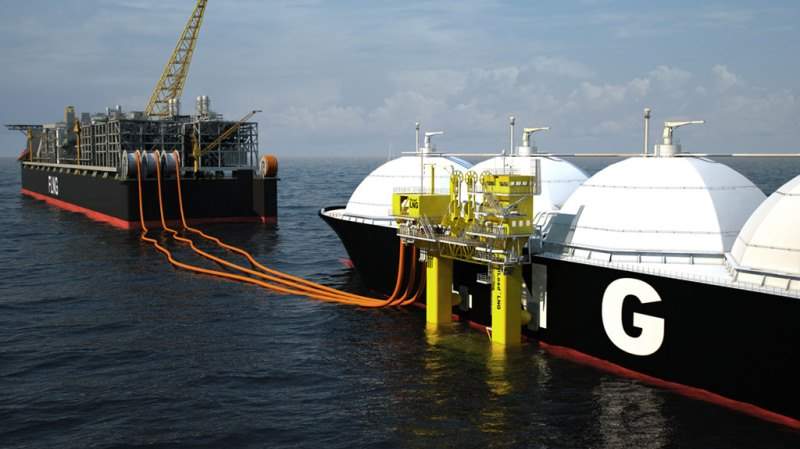
However, tandem loading and offloading allows vessels to maintain a safe distance during operations, enabling them to mitigate the risk of collision between two vessels, thereby enhancing safety.
Trelleborg is the first company to receive EN1474-2 accreditation for its 20in Cryoline LNG hoses, designed for fatigue resistance in even the most hazardous conditions.
During the development of the Cryoline hose-in-hose technology, several full scale hose prototypes were successfully tested in both static and dynamic conditions, with most tests taking place in cryogenic conditions at -196°C / -321°F, demonstrating their ability to withstand fatigue resistance in even the most perilous conditions.
The hoses can also operate in any and virtually all sea states, dramatically improving safety and allowing for faster transfer times, which in turn cuts operating costs.
For ship-to-ship floating configurations, Cryoline hoses are available with large inner diameters ranging from 16in-20in.
This will provide operators with a greater choice of configurations, offering more flexibility, and a more operationally efficient replacement to conventional ship-to-ship systems.
For example, ship-to-ship aerial transfer operations require only three 16in Cryoline hoses as opposed to ten 8in hoses; reducing handling operations by as much as 60%.
Able to extend to up to 600m away from floating receiving and distribution terminals and coastal gas carriers, Cryoline hoses ensure optimum standards in safety.
Whereas traditional transfer is conducted with numerous 8in or 10in standard hoses, Cryoline technology utlises 12in-16in hoses, enabling them to cope with an LNG flowrate of up to 10,000m3/h.
With no use of ‘Y-piece’ joints required, Cryoline technology ensures less handling, fewer potential leak points and less likelihood of pressure outage, while loading and offloading lead time is greatly reduced.
Boil-off generation during transfer presents another challenge for operators in offshore conditions, often causing a significant loss of energy during the transfer process.
Therefore the Trelleborg team focused on developing game-changing technology with insulated hoses that can reduce boil-off by as much as 60%.
This equates to a saving of ten billion BTU’s of energy saved over the course of 500 transfers.
In addition, all Cryoline technology handling solutions are supplied with built in leak monitoring systems as standard to ensure maximum operational efficiency.
Advances in technology such as Cryoline hoses have the potential to shape the future LNG market, supporting the development of LNG from its infancy into a mature and viable clean energy source.
LNG’s true potential as a clean energy source is still being discovered. But with stringent regulations continually coming into force, it is increasingly considered a realistic alternative to other more traditional energy sources.
This rapid growth can only come from the success of innovations which can facilitate this transition to compliant and efficient operations, and the industry must look to adopt these technologies to ensure commercial success.
Source: Ship & Bunker – Cryoline: Innovation in the LNG ‘Transfer Zone’.