Globally, most industrial players have pledged to achieve net-zero emission goals by a certain deadline, more commonly by 2050. It is aimed at balancing the amount of greenhouse gases released into the atmosphere with an equivalent amount removed to stabilise global temperatures and mitigate climate change. A nationwide net zero can be achieved through drastically reducing emissions across all sectors such as energy, transport, industry, and agriculture. It also involves the use of carbon dioxide removal approaches, including afforestation and technology-based carbon capture, utilisation and storage to counterbalance any unavoidable residual emissions. This is a key target of the Paris Agreement, which seeks to limit global warming to well below 2°C above preindustrial levels, preferably to 1.5°C.
Achieving net zero requires coordinated efforts from countries, cities, businesses, and individuals. Over 140 countries, including major economies such as China, the US, India, and the EU, have set or are considering net-zero targets. To stay on track for the eventual target, entities have set interim milestones on the path that are relatively short-term, science-based emissions reduction targets. For instance, to reach full net-zero emissions by 2050, global carbon dioxide emissions need to be reduced by approximately 45% by 2030 from 2010 levels. The purpose of these interim targets is to provide accountability and transparency with a focus on absolute emissions reduction within an entity's own operations and value chain. It ensures immediate and continuous action is taken, rather than deferring the majority of the reductions to the future.
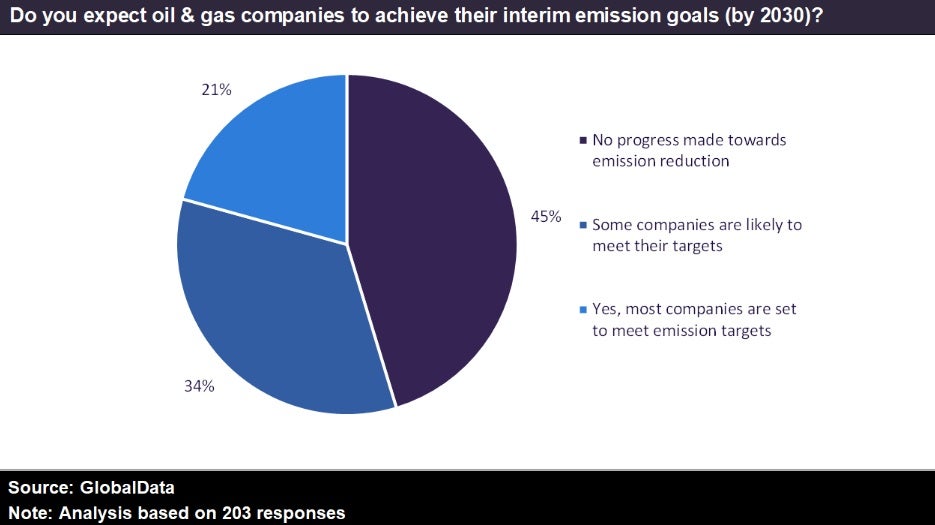
In this regard, leading data and analytics company GlobalData conducted a survey to review if oil and gas companies were on track to meet their interim emission goals. The poll was answered by 203 participants during September to November 2025. Approximately 45% of the respondents indicated that there was hardly any progress made towards achieving emission reduction. Interim goals are specific to the entity setting them and require widespread systemic changes in workflows for their success. There can be a possibility wherein a respondent might not be fully aware of where different organisations currently stand on the emission reduction front. But, in general, progress towards these goals is not uniform, and the world is currently off-track to meet the 1.5°C limit.
A central strategy in this endeavor is to transition from fossil fuels to renewable energy sources such as solar and wind power, coupled with significant improvements in energy efficiency. This requires substantial capital investment year-on-year and a determined company leadership for its implementation across varying economic cycles. Many companies had submitted their net-zero commitments in 2020-21 when inflation and lending rates globally were considerably low amid lockdowns and travel bans due to the Covid-19 pandemic. However, in 2022, commodity prices shot up with the start of the Ukraine conflict, causing a spike in inflation and pushing major economies such as the UK, Japan, and the whole of the eurozone into recession. As a result, central bankers started raising interest rates that made financing even more difficult for capital projects, potentially even making emission reduction plans unviable to some companies.
Around one-third of the survey respondents opined that some companies are likely to reach their interim goals for emission reduction. This survey was answered by industry participants from around the world, some even belonging to countries with stronger frameworks for decarbonisation. Different countries demonstrate varying levels of commitment to support robust interim goals. Continuous, immediate action is required to transition to a low-carbon economy. A strong, sustained government commitment with regulatory oversight and backed by financial incentives enable certain companies to translate their goals into reality.
Lastly, around two-fifths of the respondents seemed most optimistic over the prospects of achieving interim goals. They were of the opinion that most companies were likely to meet their emission targets. The UN had assessed the emission reduction plans submitted by over 100 countries from around the world and estimated that these efforts were not enough to support interim objectives for 2030. A key issue with these plans was that only around one-third of the countries had identified interim steps to chart a clear decarbonisation pathway. Even many long-term strategies lacked sufficiently clear policy guidance or specific emissions pathways.