

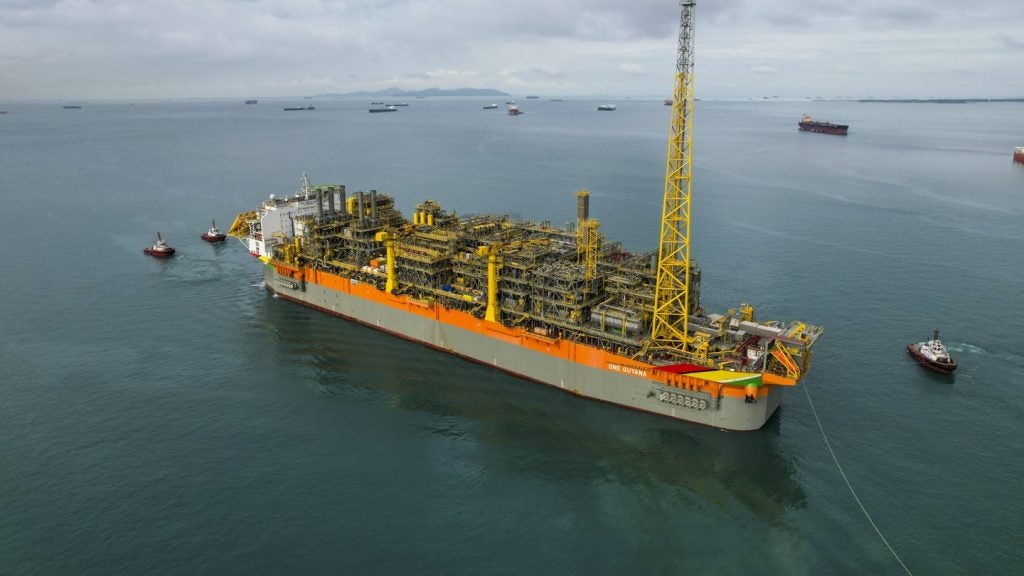
ExxonMobil Guyana has commenced production at its fourth project in the offshore Stabroek block, named Yellowtail.
This new venture is expected to significantly boost the country's oil output and joins three other projects already in operation.
The Yellowtail development's infrastructure includes one floating production, storage and offloading (FPSO) vessel named ONE GUYANA and a subsea production system.
At a water depth of 1,600–2,000m, the project is set to commission 26 production wells and 25 injection wells to maximise oil extraction.
ExxonMobil Upstream Company president Dan Ammann said: “Yellowtail’s ahead-of-schedule start-up is a significant milestone for ExxonMobil and the people of Guyana.
“With Guyanese making up more than 67% of the country’s oil-and-gas workforce and over 2,000 local businesses engaged, this project reflects our deepening roots in the country and our shared commitment to long-term, inclusive growth.”
The ONE GUYANA FPSO, part of the Fast4Ward programme by SBM Offshore, is said to be the largest FPSO in the Stabroek block to date and is moored in approximately 1,800m of water.
It is designed to produce an average of 250,000 barrels of oil per day (bopd) initially, with a storage capacity of two million barrels (mbbl). The oil produced will be marketed under the name Golden Arrowhead crude.
The FPSO's capabilities include treating 450 million cubic feet of associated gas per day and injecting 300,000 barrels of water per day to support reservoir pressure.
Looking ahead, ExxonMobil Guyana anticipates that by 2030, the combined production from eight developments will reach 1.7mbbl of oil equivalent per day.
ExxonMobil Guyana operates the Stabroek block with a 45% interest, followed by Hess Guyana Exploration with 30% and CNOOC Petroleum Guyana with 25% interest.
In a related development, the Government of Trinidad and Tobago has reportedly awarded ExxonMobil exploration rights to an ultra-deep area comprising seven blocks.
This marks the company's return to Trinidad and Tobago after more than 20 years, with the blocks located in waters with depths ranging from 2,000–3,000m, north-west of the Stabroek block.