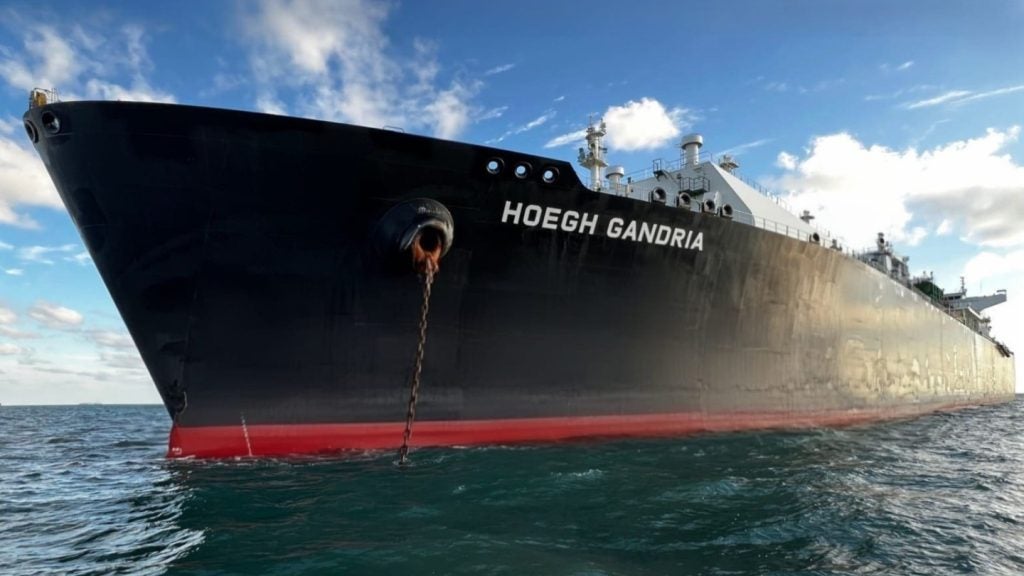
Höegh Evi, a marine energy infrastructure company, has entered into a ten-year time charter agreement with the Egyptian Natural Gas Holding Company (EGAS) for the deployment of the Höegh Gandria as a floating storage and regasification unit (FSRU) in Egypt.
The Hoegh Gandria, currently in use as a liquefied natural gas (LNG) carrier, will be repurposed to meet Egypt’s surging energy needs. It is expected to play a vital role in Egypt’s diversified and flexible energy infrastructure.
The FSRU is scheduled to be deployed in the fourth quarter of 2026 (Q4 2026) at the Port of Sumed. It will provide a peak LNG regasification capacity of up to one billion standard cubic feet per day.
The Hoegh Gandria was acquired in February 2023 to convert it from an LNG carrier to a high-capacity FSRU for long-term deployment. The conversion process is set to commence immediately.
Carrying out this conversion strengthens Höegh Evi's strategy to utilise the flexibility and high-performance capabilities of marine infrastructure.
Höegh Evi president and CEO Erik Nyheim said: “Höegh Evi is proud of our long-standing role as a trusted energy infrastructure partner to Egypt and we are excited to begin the conversion of Hoegh Gandria to a floating import terminal, highlighting the unique flexibility of marine infrastructure.
“We look forward to building on the successful long relationship we have with EGAS and supporting the growth of Egypt’s diversified energy system.”
The FSRU will replace the Hoegh Galleon, which has served as Egypt’s sole LNG import terminal.
The Hoegh Galleon was deployed to Egypt in July 2024 on a temporary charter from AIE and Höegh Evi. It is expected to stay in Egypt for up to an additional year before being deployed to the LNG terminal in Port Kembla, Australia, in 2027.
The FSRU charter comes as Egypt grapples with declining natural gas output, driven by reduced production at the Zohr gas field and rising domestic energy consumption, particularly during the hot summer months, according to a report from Bloomberg.
Production levels hit a seven-year low in September 2024, according to the Joint Organisations Data Initiative.
In a further step to bolster gas supplies, Egypt signed agreements worth $3bn (E£151.53bn) with Shell and TotalEnergies in February to procure 60 LNG cargoes.
The country is also engaged in discussions with Qatar over long-term LNG supply contracts.
The developments mark a reversal for Egypt, which transitioned from being a net LNG exporter to a net importer in the past year.