
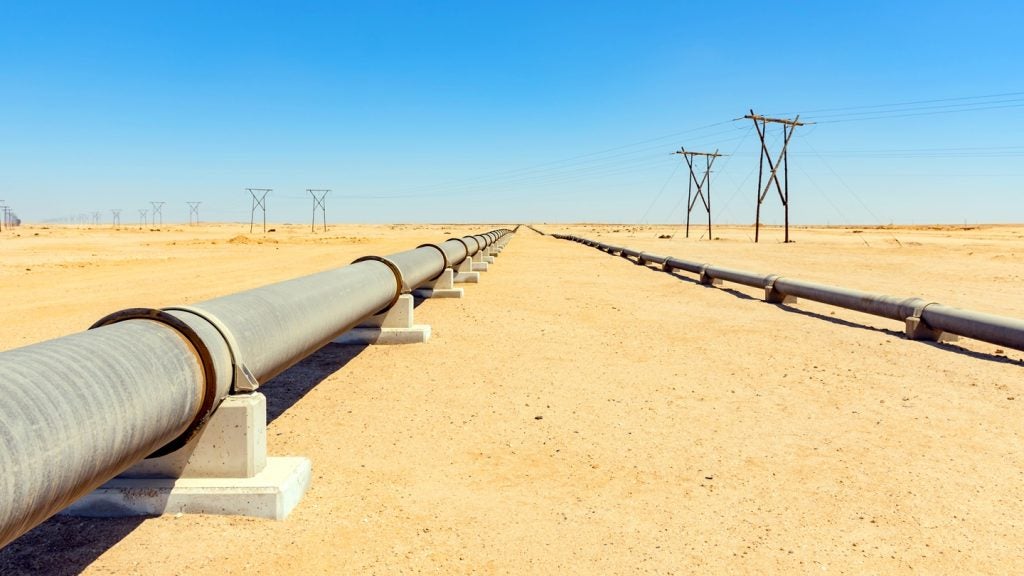
The United Arab Emirates (UAE) plans to speed up construction of a new oil pipeline to double its export capacity through the port of Fujairah by 2027, according to the Abu Dhabi Media Office.
This development is expected to increase the UAE’s ability to ship oil outside the Strait of Hormuz, a major transit route for global energy supplies that is currently affected by regional instability, reported Reuters.
Last week, Abu Dhabi Crown Prince and Abu Dhabi Executive Council Chairman Sheikh Khaled bin Mohamed bin Zayed chaired an executive committee meeting at Abu Dhabi National Oil Company (ADNOC) headquarters.
During the meeting, he directed the company to expedite the West-East Pipeline project.
ADNOC indicated that this new oil pipeline is already under construction and is expected to be operational next year.
The current Abu Dhabi Crude Oil Pipeline, which connects to Fujairah, has a daily capacity of up to 1.8 million barrels (mbbl).
Recent developments around regional security have heightened focus on alternative export routes. Since the Iran conflict began, Tehran has expanded its definition of the Strait of Hormuz and the maritime territory it claims, leading to increased tension.
On 4 May, the Islamic Revolutionary Guard Corps (IRGC) Navy published a map showing a wider zone of control that now covers much of the UAE’s Gulf of Oman coastline.
The map’s release coincided with incidents including a drone attack on an ADNOC tanker and strikes on Fujairah’s oil zone, which the UAE Foreign Ministry described as an “unacceptable transgression” and “economic blackmail”.
The UAE, alongside Saudi Arabia, is said to be the only Gulf producer with the necessary infrastructure to export outside the strait.
ADNOC aims to reach five million barrels per day (mbbl/d) of production capacity by next year, a target that was advanced by three years.
In January, before the conflict began, the UAE’s crude oil production was just under 3.4mbbl/d. Following the closure of the Strait of Hormuz, ADNOC reduced output by more than 50%.
The UAE recently withdrew from Opec, ending its output quota obligations. ADNOC Drilling has confirmed readiness to support required capacity expansions.