

The Previously Produced Fields (PPF) project involves the redevelopment of the Albuskjell, Vest Ekofisk and Tommeliten Gamma gas condensate fields located within production licenses (PL) 018B/F and PL044/D in the North Sea, Norway.
The project is being developed by ConocoPhillips Skandinavia as the operator, working with partners Var Energi, Orlen Upstream Norway and Petoro.
Recommended Buyers Guides

ConocoPhillips holds 35.1% in PL018B/F and 28.3% in PL044/D. Var Energi holds 52.3% in PL018B/F and 9.1% in PL044/D, while Orlen Upstream Norway holds 7.6% in PL018B/F and 62.6% in PL044/D. Petoro holds 5% in PL018B/F.
The estimated investment for Albuskjell and Vest Ekofisk is Nkr14bn ($1.3bn) and around Nkr5.5bn for Tommeliten Gamma.
The partners took the final investment decision on the project in December 2025.
In February 2026, two plans for development and operation (PDO) for the project were submitted to the Ministry of Energy, and the plans were subsequently approved in May.
Start-up of the PPF project is targeted for the fourth quarter of 2028 (Q4 2028).
Project location and background
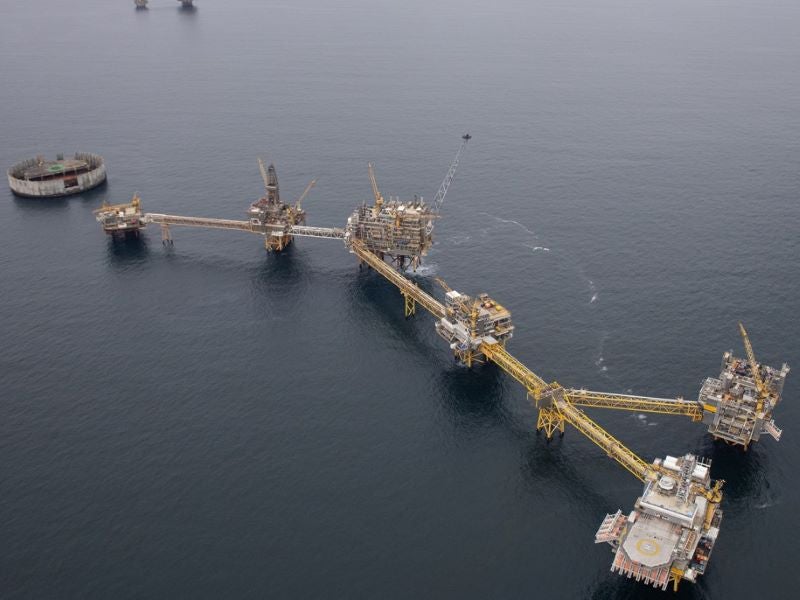
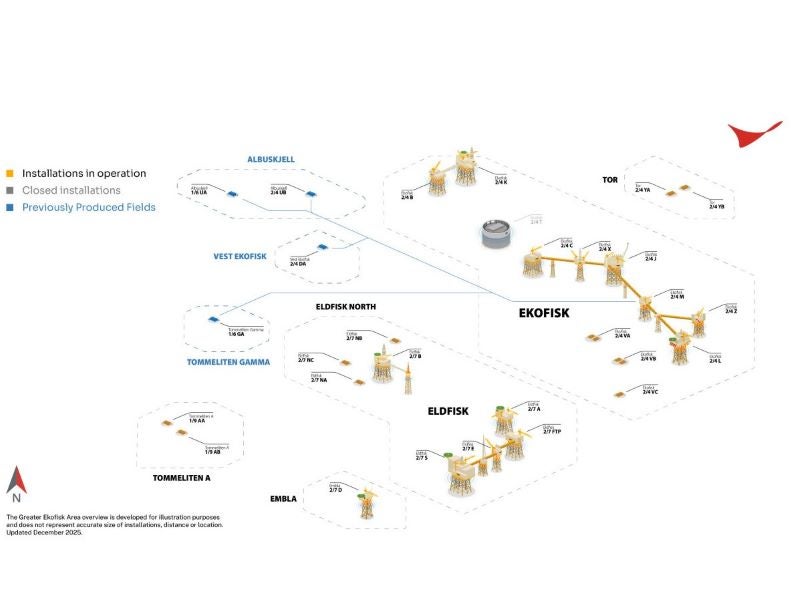
The PPF project lies within the Greater Ekofisk Area, around 290km south-west of Stavanger in the Norwegian North Sea.
The Albuskjell and Vest Ekofisk fields are located within PL018B/F, while the Tommeliten Gamma field is located within PL044/D at a water depth of 70m (229.65ft).
Vest Ekofisk was discovered in 1970, with the initial development plan approved in 1973 and first production in 1977. It was developed using a single combined facility covering drilling, production and accommodation. Production ended in 1998 and the installation was removed in 2012.
Discovered in 1972, Albuskjell received approval for its original PDO in 1975 and began producing in 1979. The development comprised two steel installations. Operations ceased in 1998 and the platforms were later removed in 2013.
Tommeliten Gamma was discovered in 1978 and the development plan was approved in 1986, with production commencing in 1988. The field was developed via a subsea template. It was shut down in 1998 and the subsea structure was removed in 2001.
Geology and reserves
Albuskjell field’s reservoirs hold gas and condensate within Maastrichtian to early Paleocene chalk, with the accumulation positioned over a salt dome. The primary pay is in the Upper Cretaceous Tor Formation at approximately 3,200m. The overlying Ekofisk Formation exhibits weaker reservoir characteristics and has seen minimal depletion.
At Vest Ekofisk, gas and condensate are hosted in fractured chalk of the Late Cretaceous age in the Tor Formation and early Paleocene age in the Ekofisk Formation. The reservoir package lies at approximately 3,200m and is also associated with a salt-dome structure.
Tommeliten Gamma likewise contains gas and condensate in fractured chalk across the Tor (Late Cretaceous) and Ekofisk (early Paleocene) formations but at greater depth, with the reservoir occurring at approximately 3,500m.
Recoverable resources for the three fields are estimated at 90–120 million barrels of oil equivalent (mboe).
PPF project details
The redevelopment of the gas condensate fields is driven by more effective well positioning and the deployment of horizontal drilling, which improves reservoir contact and flow performance, thereby materially boosting recoverable reserves.
These advances have been supported by improved well technologies and streamlined subsea solutions deployed at the Tor II, Tommeliten A and Eldfisk North fields.
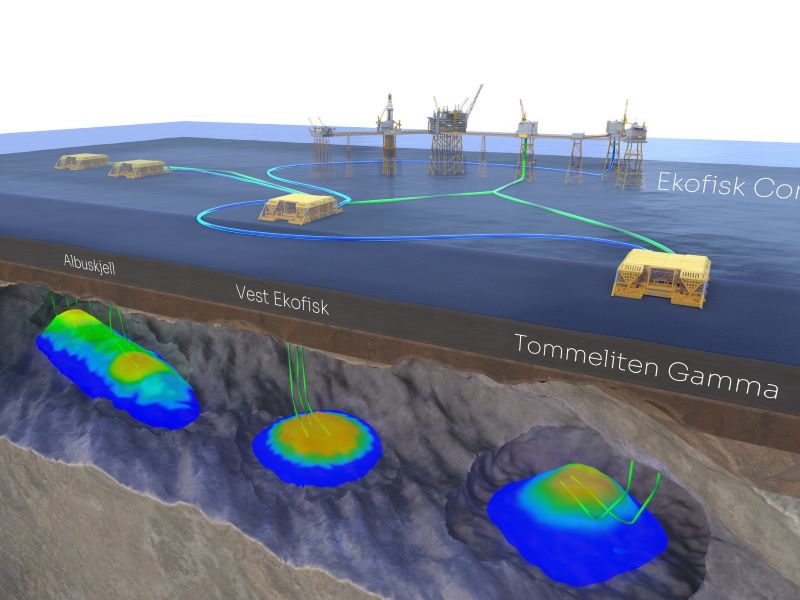
The selected development concept for the PPF project comprises 11 new wells and four new subsea templates, tied back to the Ekofisk Complex through a shared multiphase pipeline.
Albuskjell is set to have two templates and six wells, Vest Ekofisk will have one template and three wells, and Tommeliten Gamma will have one template with two wells.
Gross peak production is expected to reach 36,000 barrels of oil equivalent per day.
Contractors involved
Subsea7, a subsea engineering and construction company, received an engineering, procurement, construction and installation contract in December 2025 covering subsea structures and the associated umbilicals, risers and flowlines. The contract follows the completion of front-end engineering and design (FEED) work awarded in May 2025. The main offshore campaigns are planned for 2027 and 2028 using the Seven Borealis pipelay and heavy lift vessel.
Worley Rosenberg was awarded an engineering, procurement and construction contract in December 2025 for brownfield topside modifications at the Ekofisk Complex, with delivery targeted by autumn 2028. The company completed the FEED scope for the modifications in November 2025.
Reinertsen New Energy carried out concept development and pre-FEED studies for the subsea tie-back of the three fields.
