
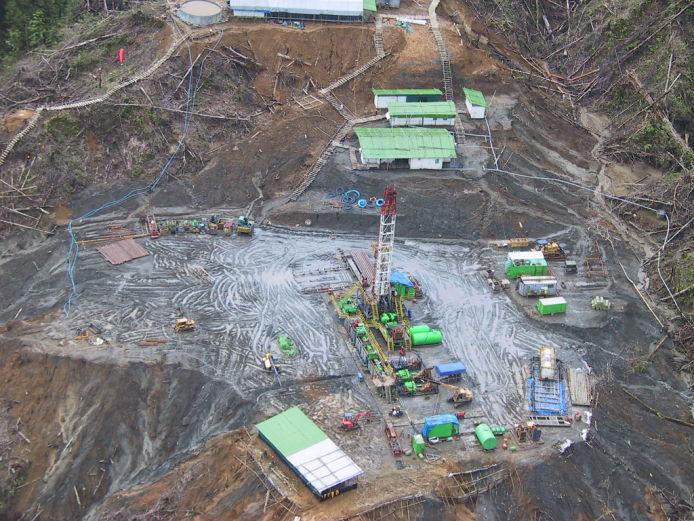
InterOil Corporation has encountered natural gas and condensate at a flow rate of 17.6 million cubic feet of gas per day in the Triceratops-2 well in Papua New Guinea.

Discover B2B Marketing That Performs
Combine business intelligence and editorial excellence to reach engaged professionals across 36 leading media platforms.
The company said that drill stem tests of the upper reservoir section in the exploration well, located in PPL237, were conducted in the open hole interval from 1,253m to 1,481m.
The well intersected natural gas and condensate through a 48in to 64in choke at separator conditions of between 13.6 and 16.3 barrels per million cubic feet of gas, with a wellhead pressure of 1,382 psig.
InterOil chief executive officer Phil Mulacek said the company believes that the pressure data, flow rates recovered from the DSTs, and well logs demonstrate a high-quality porous reservoir.
‘We are pleased to find that our aero-magnetic and gravity data, utilised in combination with modern seismic data, has yielded our second significant discovery of hydrocarbons in a reefal reservoir in Papua New Guinea," added Mulacek.

US Tariffs are shifting - will you react or anticipate?
Don’t let policy changes catch you off guard. Stay proactive with real-time data and expert analysis.
By GlobalData"We believe that the Triceratops-2 log and early DST results support our view that the prospectivity of the Gulf Province represents a world class hydrocarbon province. This is another discovery in what was an overlooked province."
The gas flow rate results were found to be similar to results from equivalent DST intervals at Antelope-1 and Antelope-2 which reported a rate of 12.4 to 18 million cubic feet per day and 11.2 to 17.4 million cubic feet per day respectively.
The company has also identified two stratigraphically separate carbonate reservoir intervals, with separate pressure systems and potential hydrocarbon pay through the logs and DST pressure data.
The deeper zone and upper reservoir were separated by an interval of 80.5m, and an argillaceous limestone interval by 1,564.5m.
The tests also recovered a small amount of condensate, while independent formation evaluations confirmed potential movable liquid hydrocarbons in lower reservoir intervals. However, the presence of hydrocarbons in the other sections of this interval have not been confirmed.
Image: InterOil has drill stem tested the upper reservoir section in the Triceratops-2 well in PPL237 in Papua New Guinea. Photo:
InterOil Corporation.


