
The KG-D6 block lies in the Krishna-Godavari basin of the Bay of Bengal on the eastern coast of India.
The block is owned by three entities, namely its operator Reliance Industries (Reliance) (66.6%) and BP (33.3%).
Recommended White Papers
Recommended Buyers Guides
It covers an area of 8,100km² and lies in water depths between 700m (2,297ft) and 1,700m (5,577ft).
The total reserves accumulated in the block are estimated at three trillion cubic feet of gas (bcf) a day and 500 million barrels of oil equivalent (mboe).
Reliance commenced conceptual studies for the development of nine natural gas discoveries near the D1 and D3 gas fields in the block. The satellite discoveries are planned to be tied back to the D1 and D3 production facilities.
A development plan for four satellite discoveries was submitted to the government in December 2009. Development of the R-Series was sanctioned in June 2017, followed by that for the Satellites cluster in April 2018. Development of the third project, the MJ deep-water gas field (D55), was approved in June 2019.
The integrated project is expected to be developed through an estimated investment of approximately Rs350bn ($5bn).
The KG-D6 discovery details
The first three discoveries made in the KG-D6 block were Dhirubhai-1, Dhirubhai-2 and Dhirubhai-3.
The estimated gas reserves accumulated in the three discoveries was approximately eight trillion cubic feet.
In March 2003, the deepwater rig Discover 534 discovered Dhirubhai-4, which featured gas in-place volumes of 1,700bcf.
In February 2006, Reliance encountered the block’s thickest hydrocarbon column to date, the MA-2 well, which is located 2km from the MA-1 discovery well.
The well was drilled to a total a depth of approximately 3.6km and penetrated a gross hydrocarbon column of 194m.
The column comprised 170m of gas / condensate with a 53°API and 24m of oil with a 42°API.
KG-D6 integrated development plan
The initial development in the KG-D6 field included the development of 22 subsea wells at depths of more than 1,200m, along with subsea equipment, pipelines, a riser platform and an onshore terminal.
The gas fields in block KG-D6 will be developed as part of a three-phase integrated project.
Phase one of the integrated project will involve the development of the R-Series field, the second phase will see the development of Satellite Cluster field, and the third will develop the MJ field.
The three projects together will develop approximately three trillion cubic feet (tcf) of gas and produce 30-35 million cubic metres (1bcf) of gas per day for the domestic market.
The projects will be developed in a phased manner between 2020 and 2022.
Development of the R-Series fields
The R-Series deep-water gas field is located in water depths of 2,000m.
The dry gas project will be developed as a six well subsea tieback to the existing Block KG-D6 platform.
The project is expected to have a production capacity of 90mboed of gas per day upon its commissioning in mid FY2020-2021.
Development of the Satellite cluster fields
The Satellite Cluster field comprises four gas discoveries located in water depths of 1,700m.
These fields will also be developed as a dry gas development project through a five-well subsea development. The development of the Satellite Cluster was completed in February 2019 and is expected to come online by 2022.
Development of the MJ field
The MJ field is a gas condensate field located in water depths of 700- 1,100m.
The field will be developed with seven subsea wells tied back to a new floating production storage and offloading (FPSO) vessel for the processing and separation of liquids. The produced gas will be exported onshore through an existing pipeline.
It is expected to come on stream in mid-2022 with an annual average production of 90mboed.
KG-D4 platform jacket
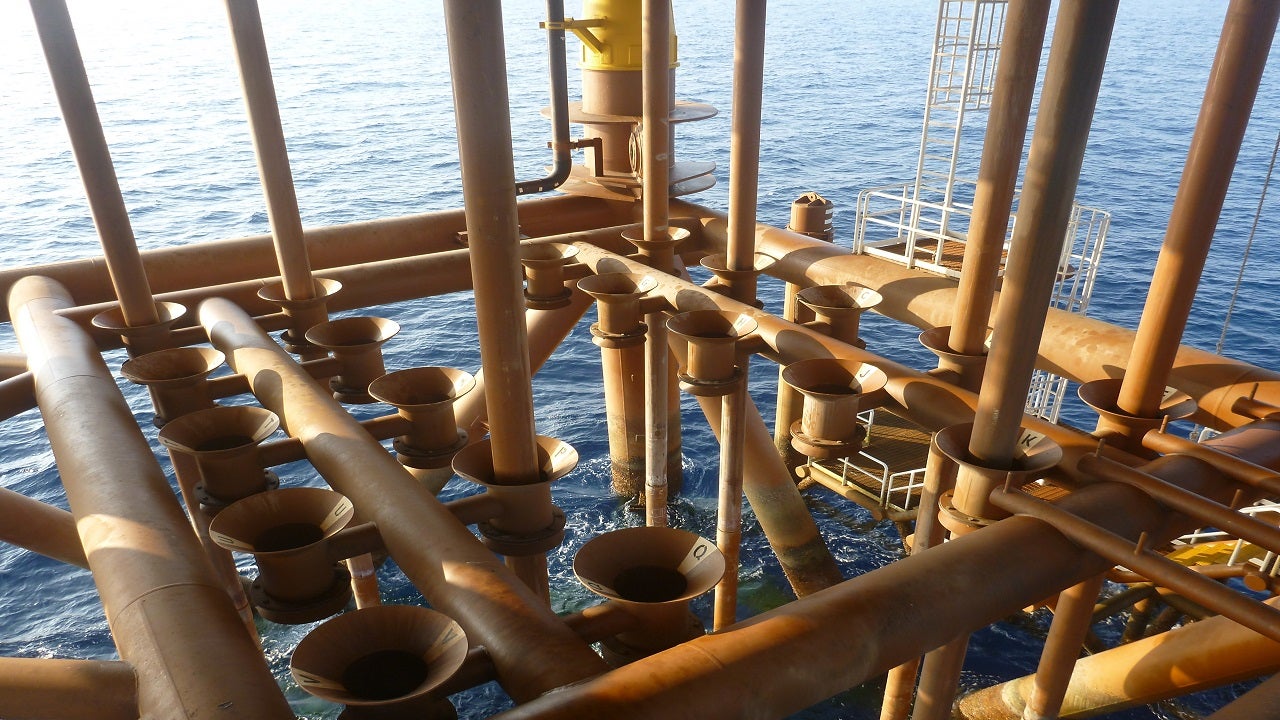
The KG-D6 platform jacket, weighing 9,015t, was built at J Ray McDermott’s fabrication facility in Morgan City, Louisiana. The piles and topsides fabricated at the company’s Jebel Ali facility in the UAE.
Its jacket and cargo barge were loaded onto a fast transport vessel (FTV) at Pascagoula, Mississippi, for a 46-day journey through the Suez Canal to the marine and fabrication base on Batam Island, Indonesia. The jacket and cargo barge were then towed for approximately 12 days to India.
A support vessel known as REM Etive was used for installation, commissioning and inspection / maintenance / repairs.
The vessel is also equipped with two work-class ROVs, crane capacity and an active heave-compensated winch system.
Contractors involved
The engineering, procurement, construction, and installation contract for the KG-D6 platform jacket was awarded to J Ray McDermott.
DeepOcean won a $166m three-year deal to provide a multipurpose subsea support vessel and related services.
REM Etive was deployed under a commercial agreement between DeepOcean and TS Marine in support of the development.
Bechtel was awarded the overall EPCM contract for the project. McDermott was contracted to provide engineering, procurement, installation and pre-commissioning.
Aker Kvaerner Subsea was responsible for the complete subsea production system under a $400m engineering, procurement and construction (EPC) contract. The company also provided the closed loop system for the project.
