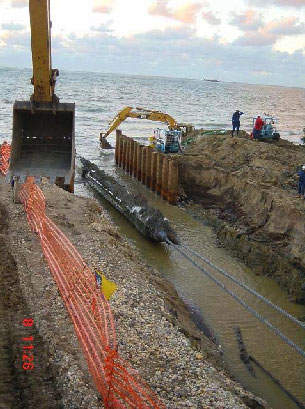
BP’s Bombax and Kapok pipeline development is part of an integrated initiative to develop BP’s gas resources from the East coast of Trinidad and Tobago.
BP’s existing pipeline infrastructure consists of a 101km, 40in pipeline from the Mahogany platform to Beachfield. The gas is then delivered by the NGC pipeline system to the ALNG plant at Point Fortin by means of a 36in onshore pipeline. The line is designed for a maximum pressure of 1,440psig.
Recommended White Papers
Recommended Buyers Guides
The liquids, which condense in the offshore line, are recovered through normal operation and pigging at Beachfield for processing at BP’s Galeota Point facilities.
The Bombax pipeline forms the initial link of a long-term expansion plan and is essentially a loop of the existing 40in pipeline system. The project consists of 63km of offshore pipeline. With a diameter of 48in, this is BP’s biggest diameter pipeline in the world. The line will double production and transportation of gas from 1.5bscfd to 3.0bscfd.
CASSIA ‘B’ PLATFORM HUB
As part of the development, the designers also specified a new 2.6bscfd production platform hub, Cassia ‘B’, that is bridge connected to the existing Cassia ‘A’ platform. This pipeline runs from Cassia B to a landfall at Rustville on the East Coast of Trinidad.
The plans also envisage a new drilling platform on Kapok. There is also a new 26in, multi-phase pipeline linking Kapok to the Cassia ‘B’ production hub.
The Kapok platform was to be ready for production before the Cassia ‘B’ hub topsides were commissioned. In order to maximise profits and allow Kapok to produce early gas the designers specified separation equipment on Kapok, exporting the liquids by a tie-in of 6in line to the existing 12in line from the Mahogany platform to shore. This tie-in required a subsea hot-tap tee.
VALVING AND PIPING MANIFOLD
To meet safety requirements the 48in pipeline exporting gas from Cassia ‘B’ would require a check valve. The designers also suggested a subsea isolation valve from the incoming 26in line from Kapok as well as a crossover to loop the 48in from the existing 40in pipelines.
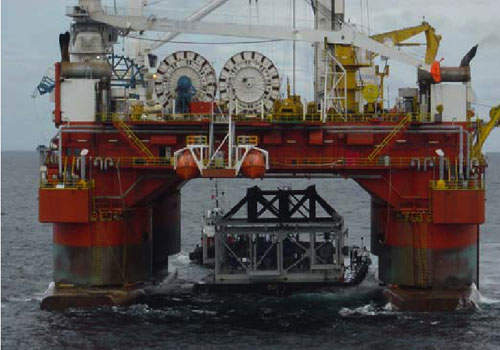
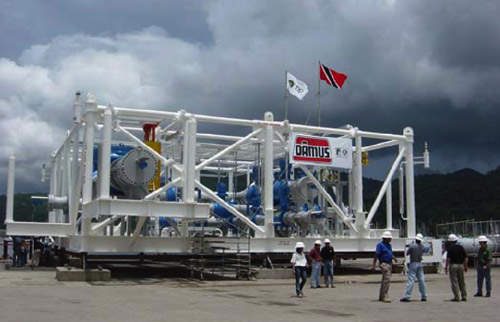
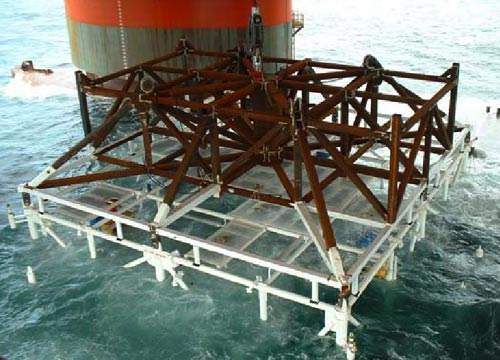
For ease of use it was decided to accommodate the valving and piping within a single 400t manifold structure. To perform the connections the designers used 48in, 26in and 20in tie-in spools of up to 300ft long and 270t.
The 400t subsea manifold is BP’s largest offshore marine structure in Trinidad and Tobago and was fabricated by local contractors.
Mustang and JP Kenny carried out the project engineering. The offshore pipeline installation went to Allseas and the onshore pipeline installation to ARB.
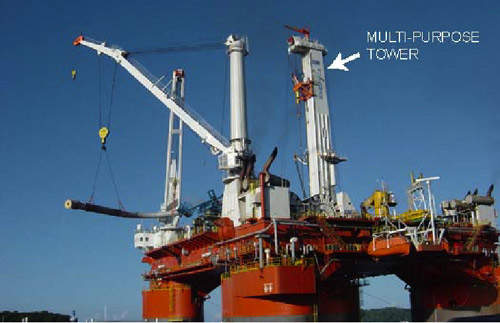
The subsea manifold was fabricated by Damus, who also made the Beachfield modifications. The manifold was installed by Cal Dive International who also carried out the tie-ins. The dynamic flow simulation was carried out by Scandpower and Sumitomo manufactured the pipe.
X65 GAS EXPORT PIPELINE
The X65 Gas Export Pipeline was divided into seven sections. All sections had an FBE anti-corrosion coating with either a 0.4mm or 0.7mm thickness, depending on the method of concrete weight coating application that was used. As the outside diameter over wall thickness ratio for most sections was greater than 45, this pipeline was rated very buckle-sensitive.
The pipeline was installed by Allseas’ Solitaire. The 48in concrete weight coated pipeline had to be pulled in at the landfall site at Rustville and laid down near the future Casia B platform at a water depth of approximately 67m. Allseas used two 500t linear winches.
The winches had a total length of approx. 12m with a width of approx. 2.2m and a height of approx. 1.6m. Each winch weighed approx. 32t. ADRA provided two 102mm pulling wires. Both wires had a minimum breaking load of 800t and an actual breaking load of approximately 859t.