


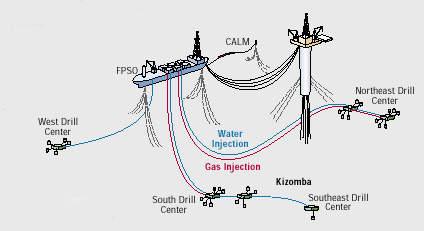
Kizomba oil field lies in Block 15 offshore Angola, marking one of the first tranches of deepwater acreage offered by the Angolan Government.
The field was jointly developed by Esso Exploration Angola (operator, 40%), ExxonMobil’s subsidiary, Agip Angola (20%), BP Exploration (26.67%) and Equinor (13.33%). Angolan state oil company Sonangol is the concessionaire.
Recommended White Papers

Recommended Buyers Guides

Block 15 was allotted to ExxonMobil in 1994, with the first production commencing from the Xikomba field in 2003.
Production from Kizomba A, Kizomba B and Kizomba C began in 2004, 2005 and 2008 respectively. The first production from Phase I of the Kizomba satellites project was achieved in July 2012.
Discovery of the Kizomba field
The joint venture (JV) partners acquired more than 2,500km² of high-quality 3D seismic data. During 1997-99, the first wildcat drilling programme took place in 1,000m to 1,400m of water, which resulted in six discoveries.
Four of the discoveries, Hungo, Chocalho, Kissanje and Dikanza, were announced in 1998 and make up the giant Kizomba field complex.
The reservoirs are from the middle to lower Miocene age. They consist of turbidity debris flows deposited along the upper / mid-slope.
The structural trap configuration is controlled by early-Aptian salt movement and lateral channel seals. The wells penetrated multiple high-quality reservoirs, giving an oil column exceeding 1,000m.
Kizomba has recoverable reserves approaching two billion oil-equivalent barrels. Other nearby fields are also planned to be tied into the Kizombo infrastructure.
The Chocalho and Xikomba fields were discovered or reappraised in 1999.
In July 2000, Esso Exploration Angola discovered another oilfield Mondo located 370km west of Luanda.
The discovery well drilled in 740m of water and encountered an oil-bearing interval, which flowed at a test rate of 4,200 barrels per day (bpd).
The well was drilled in 2,400ft of water down to a total depth of 8,200ft.
Kizomba A deepwater development
Esso Exploration Angola started construction on the Kizomba A deepwater development in 2001. The project involved the development of Hungo and Chocalho oil fields with a tension-leg platform (TLP) and an FPSO.
Kizomba A is expected to recover approximately one billion barrels of oil from the Hungo and Chocalho fields at a target production rate of 250,000bpd.In August 2004, the project first began producing oil at a rate of more than 130,000bpd.
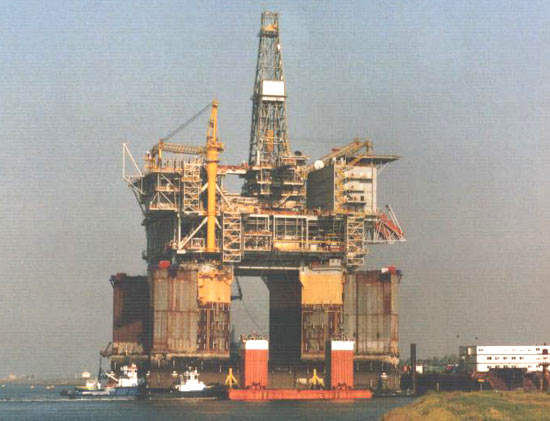
The field is operated by a combination of an ABB-designed 58,000t dry tree TLP and subsea completions, tied back to the Kizomba A FPSO. The dry tree unit is based on ABB’s ETLP design.
Kizomba A’s FPSO was built at a cost of more than $800m by Hyundai Heavy Industries, while the project development involved an estimated investment of $3.2bn.
Kizomba A had 29 production wells and one development well by the end of 2008.
Esso began construction of the Xikomba deepwater development on Block 15 in June 2002.
The first oil from the Xikomba field was produced in late 2003, making it the first oil production on Esso-operated Block 15.
Production is enabled through FPSO Xikomba, which was converted from the VLCC tanker Mosocean. The FPSO has an oil processing capacity of 100,000bpd, a gas handling capacity of 115 million standard cubic feet per day (MMscfd) and a water injection capacity of 120,000 barrels of water per day (bwpd).
In May 2011, ExxonMobil announced that production at the Xikomba field would cease as reserves had depleted.
Approximately 100 million barrels of oil were recovered from the field in total.
Later, FPSO Xikomba was upgraded by SBM Offshore and relocated to Eni’s block 15/06 under a new name N’goma FPSO.
The refurbishment and upgrade contract for the Xikomba FPSO was awarded to Keppel Shipyard in April 2012.
Kizomba A TLP details
Kizomba A TLP is located at a water depth of approximately 1,250m offshore Angola. Weighing 35,000t, the platform includes two 6,000t topsides modules, a 7,500t drilling rig, two support modules, living quarters to accommodate 100 people and 36 well slots. The TLP also contains two extensive production manifolds and related utility, power and safety systems.
Designed to receive crude and associated gasses, the TLP has the processing capacity of 260mmscfd of gas and 250,000bpd of liquids that are further exported to an FPSO for treatment, storage and off-take by a shuttle tanker.
Kizomba B: Kissanje and Dikanza discoveries
In early 2003, Esso started the construction of the $3bn Kizomba B project, which is also expected to recover approximately one billion barrels of oil, also at a target production rate of 250,000bpd.
The first oil for Kizomba B was reached in July 2005.
Kizomba B saw the development of the Kissanje and Dikanza discoveries in water depths of 3,300ft to 3,400ft.
The project includes a combination of a surface wellhead platform and subsea wells tied back to an FPSO vessel.
The design for Kizomba B duplicates Kizomba A, reducing costs and cycle time.
ExxonMobil earmarked $750m for the FPSO unit, which has a storage capacity of 2.2 million barrels of oil.
The unit measures 285m x 63m and stands 32m-tall with a weight of 81,000t and accommodation for 100 personnel.
Kizomba B had 22 production wells by the end of 2008.
Kizomba C: Mondo, Saxi and Batuque oil fields
The third phase Kizomba C is designed to develop 600 million barrels of oil from the Mondo, Saxi and Batuque fields in approximately 2,400ft of water.
Located 145km off the coast of Angola, the Mondo field started producing oil in January 2008, while the other two fields, Saxi and Batuque, started production in August 2008.
In August 2008, Saxi and Batuque started production, and between them are expected to contribute another 100,000bpd.
The Kizomba C development features two FPSO vessels and 36 subsea wells, making it the largest subsea development operated by ExxonMobil affiliates worldwide.
Approximately $1.5bn was spent on local goods and services for Kizomba C, including contracts for in-country fabrication, logistics support, training and development of Angolan personnel.
According to ExxonMobil, suppliers played an instrumental role in the implementation of the project by providing subsea manifolds, helidecks, laydown modules, umbilicals, anchor piles and specialised turret components, which were successfully fabricated in Angola.
The fabrication of the turret components was the first of its kind in Angola.
ExxonMobil’s Kizomba satellite project
In 2008, ExxonMobil launched phase one of the Kizomba satellites project, which includes the development of two satellite discoveries, Clochas and Mavacola, situated at a water depth of 4,500ft, 95 miles offshore Angola.
The two fields were developed with 18 wells tied back to Kizomba A and B production facilities. They are estimated to contain a combined 250 million barrels of oil.
The Kizomba Satellites Phase 1 began production in July 2012 with an expected peak production rate of 100,000bpd.
The Kizomba Satellites Phase 2 project, which contains Block 15 subsea infrastructure development of the Kakocha, Bavuca and Mondo South fields began production in April 2015. The project develops approximately 190 million barrels of oil with an estimated peak production capacity of 70,000bpd. The project was developed with an investment of $740m.
Contractors involved
Esso Exploration Angola awarded the contract to tie back the Clochas and Mavacola fields to Saipem in July 2009.
Saipem was responsible for the engineering, fabrication and installation of the subsea equipment, including umbilicals, risers and pipelines.
Oceaneering International was awarded the contract for supplying 34km of electro-hydraulic steel tube control umbilicals and 15km of hardwired communication link (HCL) umbilicals in August 2009.
The umbilicals are used for transmitting fluids, chemicals and power from the Clochas and Mavacola fields.
The contract for the design, procurement logistics and support services for the Kizomba satellites project was awarded to AMEC in September 2009.
AMEC executed the project in conjunction with Paragon Angola, the company’s JV with Prodiaman in Luanda.
Esso Exploration Angola selected GE Oil & Gas to provide subsea production equipment for the project on 8 September 2009.
GE provided a range of topside and subsea equipment, including subsea trees, deepwater tree connectors, jumpers, manifolds, controls equipment, umbilical termination assemblies, subsea distribution units and flying leads, under the contract.
Equipment was installed at the FPSOs of Kizomba A and B fields.
A large proportion of the equipment was produced and assembled in GE’s Angola-based manufacturing and service facility.
GE awarded a subcontract to Neptune Deeptech for the supply of five subsea tree frames in December 2009.
The company also awarded SPT Group a subcontract to supply a subsea control system training simulator in March 2010.
In June 2010, Oliver Valves was awarded a £2m contract to supply subsea and topside valves for the satellite project.
McDermott is responsible for the detailed engineering, procurement, inspection, expediting, fabrication support, completions and commissioning of Kizomba A TLP.
