
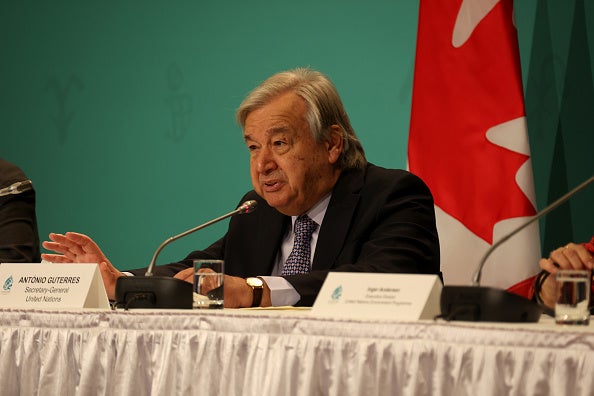
In a speech on Monday, UN secretary general Antonio Guterres told fossil fuel producers that they must “set a credible course for net zero”.
In the address Guterres outlined his 2023 priorities, including the halving of global emissions this decade.
Go deeper with GlobalData


Discover B2B Marketing That Performs
Combine business intelligence and editorial excellence to reach engaged professionals across 36 leading media platforms.
As part of the speech, he delivered a “special message” to fossil fuel providers stating “if you cannot set a credible course for net-zero, with 2025 and 2030 targets covering all your operations, you should not be in business. Your core product is our core problem.”
The secretary general called for a “renewables revolution” over a “fossil fuel resurgence”, admonishing the “bottomless greed of the fossil fuel industry and its enablers”.
National governments are encouraged by the 2015 Paris Agreement to cut emissions by half in 2030, and to net zero by 2050 in order to keep global warming under 1.5⁰C. Guterres is aiming to increase this pressure.
Guterres plans to convene a “no-nonsense” climate ambition summit in September of next year. During a press conference, in December, he stated that there would be “no room for back-sliders, greenwashers, blame-shifters or repackaging of announcements of previous years.”
Guterres has grown increasingly critical of the fossil fuel industry. In an address at the World Economic Forum this January, Guterres accused some in “Big Oil” of peddling a “big lie”.
In October 2021 a US congressional committee hearing questioned big oil CEOs over their role in decades of climate misinformation. Chairwoman Representative Carolyn Maloney accused ExxonMobil of lying about discoveries made by climatologists in the 1970s which suggested a link between rising global temperatures, pollution and fossil fuels.
A study from the same period found archival evidence to suggest that the oil group, now known as TotalEnergies, knew about the climate consequences of burning fossil fuels as early as 1971. The article, published by academics at CRNS, Sciences Po and the University of Stanford accuses the company of “overt denial of climate science”.
As part of their climate action efforts, the UN has vowed to “break up with” fossil fuels, stating that fossil fuel subsidiaries from national governments must be stopped.


