

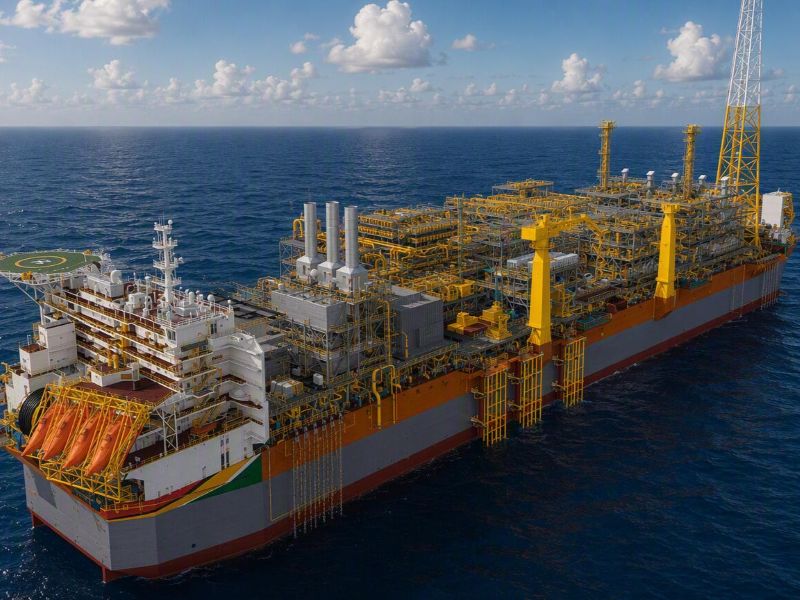
Longtail is an offshore non-associated gas field in the Stabroek Block approximately 193km off the Guyanese coast.
ExxonMobil affiliate ExxonMobil Guyana operates the asset with a 45% interest. Hess Guyana Exploration holds a 30% interest and CNOOC Petroleum Guyana retains the remaining 25% interest.
Recommended White Papers

Recommended Buyers Guides

Following the receipt of statutory government and regulatory approvals, the operating partners reached a final investment decision (FID) in November 2026.
Commercial production from the project is anticipated to start in 2030.
Longtail project location
The Longtail field lies in the south-eastern section of the Stabroek Block, which spans 6.6 million acres (26,800km²) offshore Guyana. It lies at a water depth of 1,750m (5,741ft).
Longtail is the eighth discovery within the Stabroek concession, following the Liza, Payara, Liza Deep, Snoek, Turbot, Ranger and Pacora discoveries.
Discovery and appraisal at Longtail field
Hydrocarbons at the Longtail field were first encountered in June 2018 by the Stena Carron drillship via the Longtail-1 exploration well. The well penetrated roughly 256ft of oil-bearing sandstone reservoir, reaching a total depth of 18,057ft in water depths of 6,365ft.
Appraisal activities began in March 2021 with the Longtail-2 well, which completed drill stem testing during the fourth quarter (Q4) of 2021.
In June 2021, the Stena DrillMAX drilled the Longtail-3 well in more than 6,100ft (1860m) of water, approximately two miles (3.5km) south of the initial discovery well. The appraisal intersected 230ft of net pay, verifying deeper reservoir zones beneath the strata identified by Longtail-1.
Longtail development details
The Longtail development project will target non-associated gas and condensate-bearing reservoirs across the block.
The development plan includes the drilling of 45 production and injection wells tied back to a floating production, storage and offloading (FPSO) vessel configured to handle 1.2 billion cubic feet (bcf) per day of natural gas alongside a yield of up to 250,000 barrels per day (bpd) of condensate.
The wells will be connected to seabed manifolds, which will direct well stream fluids into the FPSO through subsea flowlines. Excluding dynamic risers, flowlines and umbilicals will extend between 1km and 2km in water depths ranging from 1,600m to 2,000m.
Three to four dynamic umbilicals linked to the FPSO vessel will support the development, with six to ten static or in-field umbilicals connecting drill-centre hardware, including subsea trees, manifolds, jumpers, and flying leads.
The subsea architecture will be operated via a central control umbilical powered by water-based hydraulic fluid. Routine flaring will be eliminated under the development plan, as excess gas is designated for onboard fuel or reinjection into the reservoir to bolster liquid hydrocarbon recovery.
Extracted gas is planned to be transported onshore via pipeline, depending on future commercial agreements, market consumption, and infrastructure development.
FPSO details
The planned FPSO for the Longtail project will be a new-build installation configured with double-side and single-bottom hull protection. Built in accordance with SBM Offshore’s Fast4Ward programme, the vessel uses the builder’s tenth new-build multi-purpose floater hull.
The unit will measure 334m in length and 60m in width, with an operating draft of 32.8m, and will be moored approximately 200km offshore. Held in position by a spread mooring system in approximately 1,750m of water, the unit will provide storage capacity for two million barrels of condensate.
Stabilised condensate will remain in the onboard storage tanks until transferred to conventional shuttle tankers for delivery to export markets.
Contractors involved
In November 2026, SBM Offshore was awarded contracts by ExxonMobil Guyana to construct and install the FPSO. The company is expected to operate the vessel for an initial period of ten years.
In the same month, TechnipFMC was contracted to supply subsea production systems for the project. The scope covers project management, engineering, and manufacturing across the entire subsea production system, incorporating Subsea 2.0 trees, manifolds, and associated controls. The company was also selected to design and manufacture flexible production risers for the development.
In November 2026, Saipem received authorisation from ExxonMobil Guyana to begin executing the project. Saipem had previously received a Limited Notice to Proceed (LNTP) in April 2026 for preliminary detailed engineering activities and procurement of long-lead equipment.
The contract covers the engineering, procurement, construction, and installation (EPCI) of the subsea structures, umbilicals, risers, and flowlines (SURF) system. Saipem will conduct offshore work using vessels from its fleet, including FDS2, Castorone, and Constellation.
