Asia is poised to spearhead the global polyethylene terephthalate (PET) capacity additions by 2030, mainly due to its escalating demand for PET from various end-use application segments such as packaging, fabrics and textile industries. Moreover, the region benefits from favourable raw material availability and low labour costs, making it cost-effective for mass PET production.
Asia is anticipated to add a PET production capacity of 6.40 million tonnes per annum (mtpa) during 2025 to 2030 from three planned and three announced projects. China, Brunei, India, and Vietnam are the only countries that account for the capacity additions in the region. China is poised to lead, with a capacity of 2.90mtpa from three upcoming projects by 2030.
However, the highest capacity addition in the region is expected from an announced project in Brunei, namely the Brunei Hengyi Industries Pulau Muara Besar Polyethylene Terephthalate Plant. It is expected to commence operations in 2029, with a capacity of 2.20mtpa. Hengyi Industries Sdn Bhd is the designated operator of this project being planned in Pulau Muara Besar.
The Zhejiang Petrochemical Daishan Polyethylene Terephthalate Plant 2 in China, and the Reliance Industries Dahej Polyethylene Terephthalate Plant 2 in India are the other major projects in the region, with capacities of 2.0mtpa and 1.0mtpa, respectively.
Global upcoming PET capacity additions by key regions, 2025-2030 (mtpa)
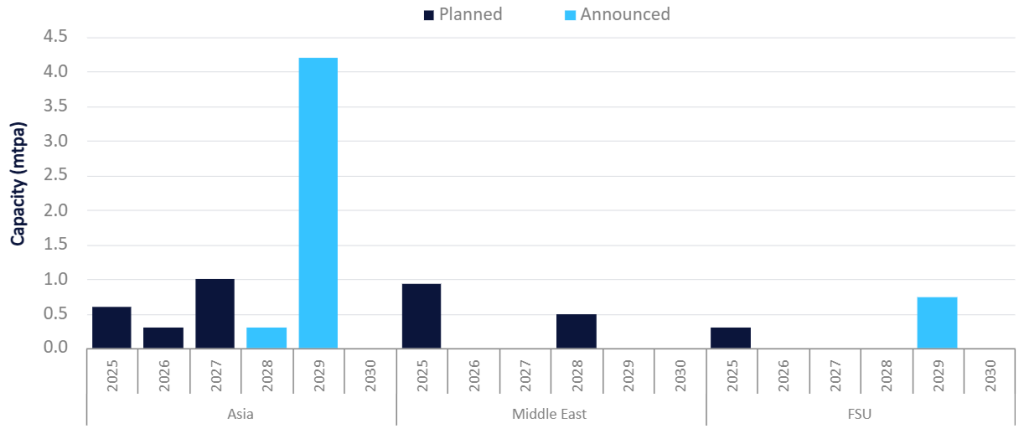
The Middle East and the Former Soviet Union (FSU) are the other key regions that are expected to add a capacity of 1.44mtpa and 1.04mtpa, respectively, by 2030. The capacity additions in the Middle East are from four planned projects, two each in Saudi Arabia and Turkey. The FSU, on the other hand, is also expected to witness a capacity addition of 0.74mtpa and 0.30mtpa in Kazakhstan and Uzbekistan, respectively.
Further details of global PET capacity and capex analysis can be found in GlobalData’s new report, 'Polyethylene Terephthalate (PET) Industry Capacity and Capital Expenditure Forecasts with Details of All Active and Planned Plants to 2030'.