
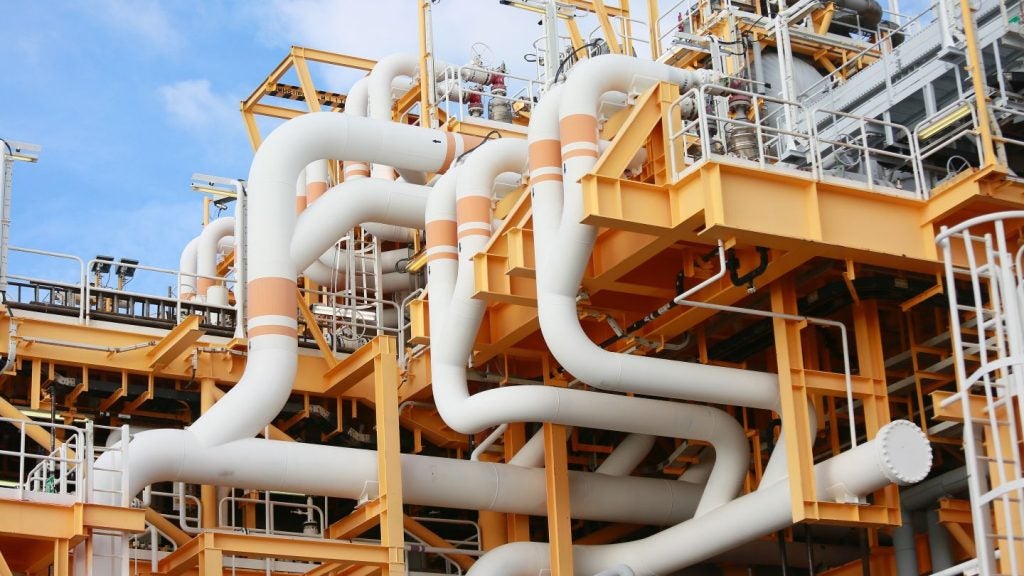
Operations at ADNOC’s Shah gas field in the United Arab Emirates (UAE) have been halted as authorities evaluate damage caused by a drone attack.
The Abu Dhabi Media Office said the fire sparked by Monday’s drone attack is under control, adding in a post on X that no injuries have been reported.
Situated approximately 180km south-west of Abu Dhabi, the Shah gas field ranks among the largest sour gas fields globally. It is operated by ADNOC Sour Gas, a joint venture (JV) between ADNOC and Occidental Petroleum.
The associated Shah gas plant has the capacity to produce 1.28 billion standard cubic feet per day (bscf/d) of gas and 4.2 million tonnes per annum of sulphur. The plant includes substantial gas processing facilities and sulphur recovery units.
The Shah gas plant is described as the world’s only single facility processing more than one billion cubic feet per day of ultra-sour gas. It is also said to lead global granulated sulphur production, contributing around 5% of total global supply.
The JV also produces other commodities such as condensate, ethane and natural gas liquids for distribution within ADNOC group companies or domestic markets.
Meanwhile, the Fujairah Oil Industry Zone, also in the UAE, continues to come under attack from Iran, although the latest incident caused no injuries, reported Reuters.
The UK Maritime Trade Operations Centre stated that a tanker, positioned 23 nautical miles east of Fujairah, was struck by an unknown projectile, resulting in minor structural damage.
These events underscore ongoing disruptions to the UAE's energy sector, which have led to a significant reduction in daily oil output.
Adding to these, the closure of the Strait of Hormuz has compelled ADNOC to enforce production cutbacks.
Despite these challenges, loading activities at Fujairah port, a crucial export hub, have partially resumed after being suspended twice due to drone attacks.
Amidst all the escalations, oil prices experienced an upswing on Tuesday, climbing nearly 3% due to concerns over supply constraints linked to the near-complete shutdown of the Strait of Hormuz, Reuters reported. The gains were also driven by reluctance from US allies to provide naval escorts through the critical waterway.
By 07:34 GMT, Brent crude futures increased by $3.07 to $103.28 per barrel, while US West Texas Intermediate crude rose by 3.6% or $3.35 to reach $96.85.
In another development, Iran has appealed to India to release three tankers seized earlier this year amid negotiations for safe passage of Indian vessels via the Strait of Hormuz.
As part of efforts to manage escalating energy costs, the International Energy Agency has suggested that member nations might consider further releasing oil reserves beyond the already agreed 400 million barrels.