

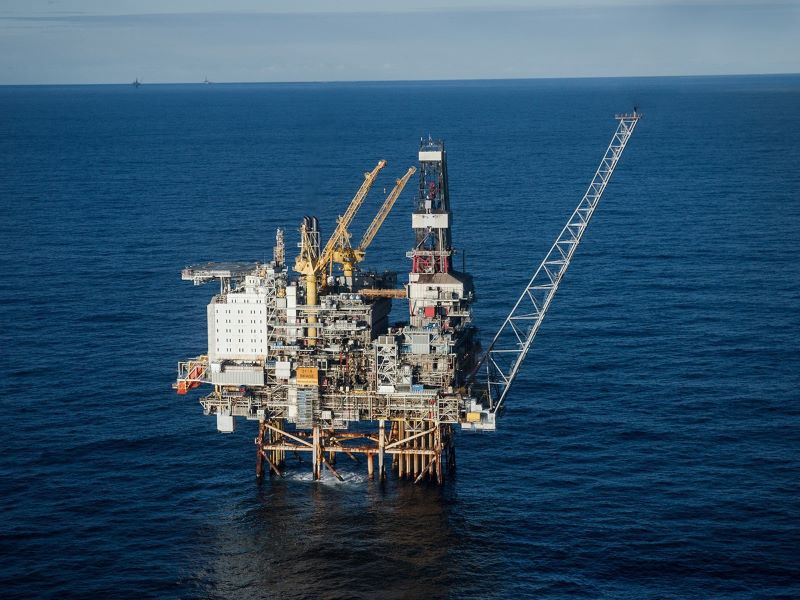
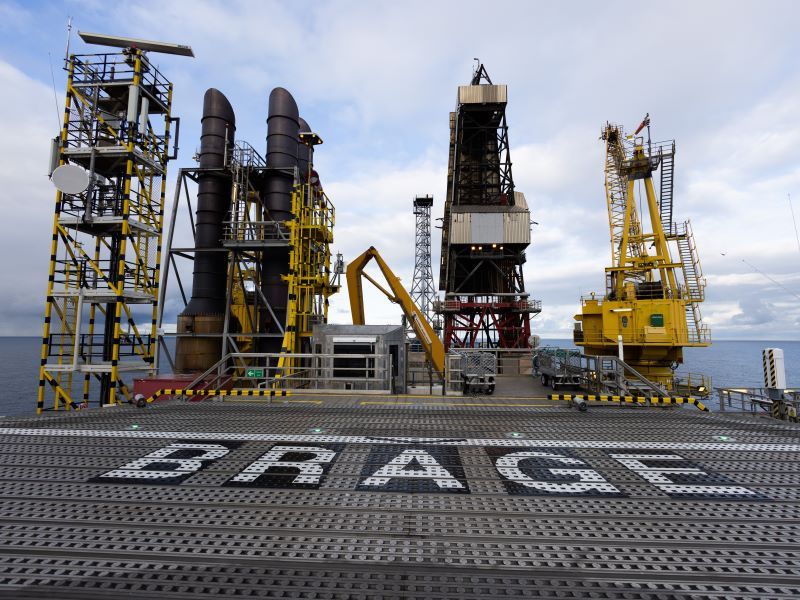
The Bestla (formerly Brasse) field lies in blocks 30/9 and 31/7 of production licence (PL) 740 in the North Sea, Norway.
PL740 is jointly owned by OKEA (39.27%, operator), DNO Norge (39.27%), Lime Petroleum (17%), and M Vest Energy (4.44%).
Recommended White Papers

Recommended Buyers Guides

The development partners were awarded additional exploration licences in the production licence, including the Bestla extension on the eastern side of the Brage field in January 2017.
In April 2024, a final investment decision was taken to proceed with the development of the Bestla field using a tie-back to the nearby Brage field production facilities. The plan for development and operation was submitted to the Norwegian Ministry of Energy in the same month and approved in November of the same year.
Drilling of the field’s two production wells by the rig Deepsea Yantai was completed in January 2026.
The field will be developed with an investment of approximately $571m (Nkr5.3bn), with first oil expected in early 2027.
Location
Bestla is located in the northern North Sea, around 13km south of the Brage field, at a water depth of 120m.
Discovery of the Bestla field
Bestla was discovered during the drilling of the 31/7-1 well in May 2016.
The well was drilled to a depth of 2,780m by the Transocean Arctic rig and encountered an 18m gas-bearing and 21m oil-bearing Jurassic sandstone reservoir of good quality.
Fluid sampling was performed to confirm the presence of oil and gas.
A sidetrack of the discovery well was drilled in July 2016 to appraise the south-eastern part of the Bestla reservoir.
The sidetrack well was drilled to a depth of 2,530m by the Transocean Arctic rig and encountered a 25m oil column and a 6m gas column in good-quality Jurassic reservoir sandstones similar to those of the discovery well.
The main purpose of drilling the sidetrack was to delineate the discovery area, reduce uncertainty regarding the reserves and gain additional information to develop the project.
Bestla field geology and reserves
The reservoir holds oil beneath a gas cap within Late Jurassic sandstone of the Sognefjord Formation. It lies at a depth of around 2,150m and reservoir quality varies across the interval.
The Bestla field is estimated to contain 24 million barrels of oil equivalent (mboe) gross in recoverable reserves.
Appraisal drilling
In February 2019, Faroe Petroleum, the then operator of the field, completed appraisal drilling of wells 31/7-3 S and 31/7-3 A, located roughly 10km south of the Brage field and around 120km west of Bergen in the northern North Sea.
Drilling was carried out by the Transocean Arctic rig. The 31/7-3 S well reached a vertical depth of 2,273m and the 31/7-3 well reached a depth of 2,254m below sea level. Both wells were drilled to total depth in the Middle Jurassic Fensfjord Formation. The water depth at the location is 124m.
Well 31/7-3 S was intended to define the north-eastern extent of the producible oil and gas accumulation in the Sognefjord Formation. It penetrated around 105m of the formation, including 45m of effective reservoir, largely with very good reservoir quality. However, the interval proved to be aquiferous, and the well was ultimately deemed dry.
Well 31/7-3 A was designed to assess the northern part of the discovery within the licence area and further delineate the reservoir. It encountered a 15m gas column above a 47m oil column in the Sognefjord Formation, with 12m of effective reservoir showing poor-to-moderate quality.
The oil-water contact was measured at approximately 20m deeper than in the 31/7-1 discovery well, and the formation thickness was around 75m. After the drilling operations, the wells were plugged and abandoned.
Bestla field development details
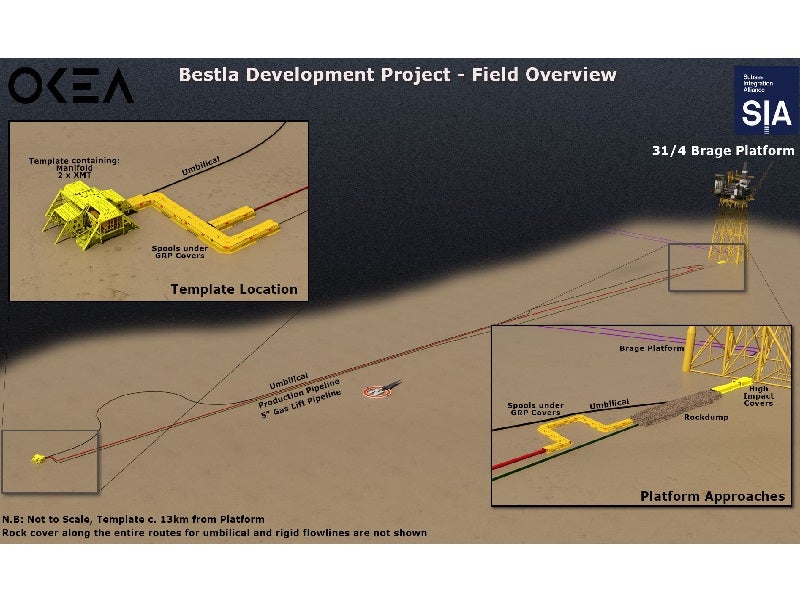
Bestla is planned as a 13km subsea tie-back to the Brage platform. The reservoir will be produced under depletion, with pressure support expected primarily from the aquifer and secondarily from the gas cap.
The proposed development includes two horizontal oil producers in the main segment, positioned roughly mid-height within the 24m oil column.
Production from the two subsea wells will be commingled via a shared manifold and routed to the Brage field through a 10in pipe-in-pipe flowline for processing on the Brage platform.
Oil will then be exported by pipeline to Oseberg and onwards through the Oseberg Transport System to the Sture terminal in Norway.
Gas will be sent via a tie-back to the Statpipe system, processed onshore at the Kårstø gas plant and subsequently exported to European markets.
The field’s subsea template was installed in June 2025, and the first production well was spud in August 2025.
The two production wells have been securely suspended as of January 2026 and are expected to be prepared for the Christmas tree installation programme in Q3 2026.
Contractors involved
Well Management company AGR provided well completion, logistics and cost management support services for drilling of the Bestla sidetrack well.
In 2024, Aker Solutions secured a major engineering, procurement, construction, installation and commissioning contract for the project. Under the award, the company is responsible for modifying the Brage platform topsides to enable the reception of oil and gas produced from the Bestla field.
In May 2024, SLB announced that OKEA had awarded an integrated engineering, procurement, construction and installation (EPCI) contract to its OneSubsea joint venture alongside Subsea7. Under the deal, the partners will deliver the subsea scope of the Bestla development.
Faroe Petroleum signed a contract with Odfjell Drilling for its Deepsea Bergen semi-submersible drilling rig to carry out the drilling operations.
